



Building APIs for financial services feels like walking a tightrope where one wrong step leads to a total collapse of trust.
You are not just moving data as you are managing the lifeblood of digital value. Most teams struggle because they treat security as a box to check instead of the foundation of their code.
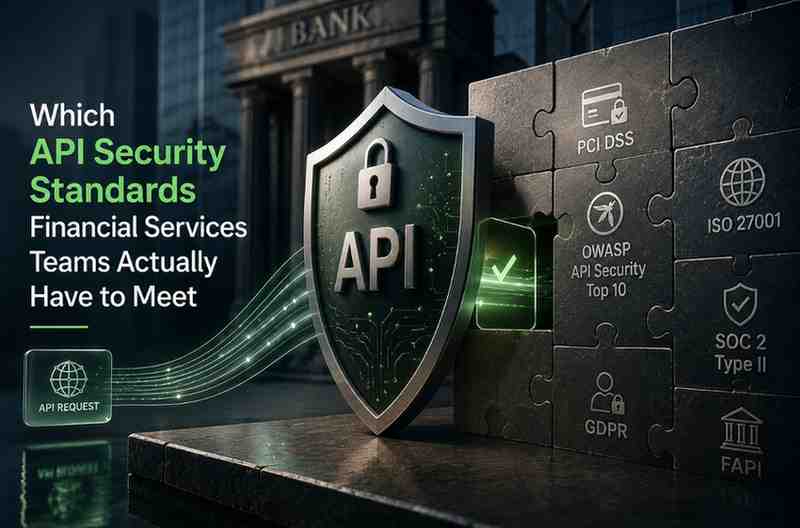
To survive today you must master the API security standards financial services require. This guide breaks down exactly how to align your architecture before an auditor forces your hand.
Why API Security Works Differently in Financial Services
Standard web security focuses on keeping outsiders away from general data. Financial systems operate on a different level because a single mistake causes immediate loss of funds and major legal issues.
You are responsible for ensuring every piece of data stays private and accurate. Every line of code you write must prioritize the safety of the assets moving through your system.
Financial leaders today agree that security is a major business risk and it is not just a tech problem. API attacks against financial institutions have increased a lot in recent years. This makes APIs a main security focus for many organizations. You must map every data path and you cannot just trust standard tools.
- Verified access is non-negotiable. You cannot treat financial traffic like regular website visits. Sensitive financial API requests should include strong authentication and appropriate sender-constrained mechanisms. These mechanisms include mTLS and DPoP. Every single request needs clear proof of the sender and what they can do with the funds.
- You cannot treat financial traffic like regular website visits. API attacks against financial institutions have increased a lot in recent years. This makes APIs a main security focus for many organizations. Every single request needs clear proof of who is sending it and what they can do with the funds.
- Regulations define your technical path. Financial institutions must comply with applicable rules and regulations. Industry standards like OAuth and OpenID Connect help build secure APIs. FAPI is another standard that helps satisfy many regulatory expectations. You are always audited to prove your code keeps transactions safe and verifiable.
- External connections increase danger. You likely share data with many partners and outside apps. FAPI 2.0 strengthens OAuth and OpenID Connect security for financial APIs. You should combine this with broader API security controls. These controls include monitoring and rate limiting. You also need secure API gateways.
The Three Layers of Standards You Are Accountable For
Financial teams often struggle because they try to treat all security rules as one single task. In reality you have to separate your work into three distinct layers to stay safe and compliant.
This approach helps you fix issues at the right level instead of trying to patch everything at once. Focusing on these layers keeps your infrastructure audit-ready while letting you build features faster.
Regulations You Cannot Opt Out Of
Global and local laws set the baseline for what you must build. You cannot pick and choose these rules. Non-compliance may result in big regulatory penalties and enforcement actions. It can also cause operational restrictions and legal consequences depending on your area.
- Mandatory legal guardrails. You must comply with regulations such as PSD2 and implement appropriate API security standards. These standards support those regulatory requirements and protect the public. Your firm must prove compliance through every transaction log.
- Audit readiness at scale. Regulators require you to show how you protect data across every endpoint. You have to document your security posture so that your logs can pass a manual review at any time.
Security Profiles That Harden OAuth
Standard authentication is rarely enough for money transfers. You need extra layers that force machines to prove who they are before they can move any funds.
- Hardened identity checks. Standard OAuth is just the start for your team. You must add extra security checks to confirm that the app making the request is exactly who it claims to be.
- Risk-based authentication. Adaptive authentication can trigger extra verification for unusual activity. FAPI strengthens OAuth-based authorization and client authentication. It ensures that an attacker cannot move money even if a password is stolen.
Engineering Baselines Auditors Expect
Auditors care less about your features and more about your setup. They look for specific technical patterns that prove your system is stable and safe.
- Consistent traffic control. You need to show that you throttle and validate all API traffic. Auditors want to see that you have automated systems to block bad requests before they hit your core database.
- Version and patch discipline. You must demonstrate a clear plan for how you update your APIs. Following established FAPI profiles helps standardize secure API implementations across systems. This keeps your technical documentation clean and clear. Auditors then see a predictable and secure environment.
FAPI Is the Standard Most Teams Get Wrong
Many teams treat financial standards like a checklist for a regular website. They assume that if they meet the basic requirements they are safe. This is exactly where the biggest problems start because financial data needs much more than just a standard lock. If you treat this standard as a simple box-ticking exercise you will eventually face a massive security gap that audits will easily catch.
What FAPI Actually Is
Think of this as the gold standard for how banking apps talk to each other. FAPI strengthens authentication and authorization. It ensures that applications accessing sensitive financial data are verified using stronger security mechanisms. This adds strict rules that prevent data leaks during a transaction. It ensures that when an app asks for your balance it is verified at a high level.
- Bank-grade identity rules. It forces apps to prove their identity in a way that regular web apps never do. This creates a secure tunnel for every single request.
- Protection for high-value data. It was built specifically to handle money and personal assets. By using API security logic here you ensure that every interaction is backed by cryptographic proof.
FAPI 1.0 Advanced
This was the first real step in making web standards work for banks. It forced developers to use stronger encryption for every message passed between systems. It is still widely used today but it requires you to be very careful with your configuration.
- Stronger message security. You must sign every request to prove it came from a trusted source. FAPI 1.0 Advanced requires signed request objects and other cryptographic protections. These are used in specific OAuth authorization flows. This keeps data safe and it works even if someone manages to intercept the traffic.
- Built for complex setups. It handles the messy parts of connecting different banks to third-party services. It keeps these connections stable even when things get busy.
FAPI 2.0 Security Profile
This version takes the lessons from the past and makes them much easier to implement. It removes the confusing parts of older versions and focuses on what actually stops attackers today. You should look at this as the modern way to keep your integration points secure.
- Simpler security paths. It cuts down on the extra steps that used to confuse developers. This makes it easier to follow the FAPI 2.0 Security Profile without getting lost in technical debt.
- Harder for attackers to guess. FAPI 2.0 adopts modern OAuth security practices. It also removes legacy mechanisms that have become harder to secure. This approach uses updated encryption methods and it makes your setup much tougher to crack. It is the best way to keep your modern apps safe.
Which Version to Adopt
You need to pick the version that fits your current infrastructure and local legal requirements. It is not always about using the newest one but about using the one that your auditors and partners understand best. Sometimes you might even need to support both versions to keep your connections running smoothly.
- Match your partner needs. Many banks are still tied to older systems that only speak version 1.0. Check your ecosystem before you decide to switch everything over.
- Future-proof your stack. If you are building something new you should aim for the latest standards right from the start. This saves you from having to rework your api security standards financial services compliance later on.
Where Financial API Security Actually Breaks
You might think your system is solid because you passed a scan or a basic audit. The reality is that most security failures happen in the gaps between what you built and how the real world actually uses it. These breaks occur where complex banking logic meets the messy reality of global networks.
Standards That Assume You Built the Plumbing
Many developers assume the underlying frameworks handle all the heavy lifting automatically. You might trust your base libraries to manage token expiration or traffic flow perfectly every time.
The break happens when your specific business logic creates a corner case the standard did not plan for. OAuth and FAPI secure authentication and authorization. You must secure application-specific business logic separately. This prevents your system from being technically compliant but fragile when users act in ways you did not expect.
- Logic gaps in automated tools. You cannot rely on off-the-shelf code to handle your unique banking rules. You have to manually verify that your business logic does not bypass the security controls you worked so hard to put in place.
- Trusting defaults too much. Default configurations are designed for convenience rather than high-stakes security. If you do not customize these settings to match your specific risk profile you are just using a lock that everyone else already knows how to pick.
Auth Built for Humans, Not Machines
Traditional authentication flows were made for users typing passwords into a browser. Now you have machines talking to machines at lightning speed and that changes everything.
When you force a machine to act like a person you create delays and security flaws that attackers love to exploit. You need a flow that treats a server request differently than a human login.
- Latency as a security risk. If your auth process takes too long because it expects human interaction your developers will try to create shortcuts. Those shortcuts are exactly where the real security leaks begin.
- Broken machine identities. Machines need their own clear identity that does not rely on a user being present. If you do not give them proper machine-to-machine credentials you are forcing them to borrow permissions that were never meant for them.
Consent and Access That Drift Out of Compliance
You might get your consent screens and access levels perfectly right on day one. The problem is that user needs and partner requirements change constantly after the first launch.
Over time you end up with access permissions that are far too broad or simply outdated. This drift is how unauthorized apps eventually get hold of data they should never have seen.
- Permission creeps over time. Partners often ask for more data than they actually need to run their services. Access permissions should be periodically reviewed. This ensures partners retain only the minimum privileges required. If you keep giving access for every request you will wake up one day and find your API is leaking private information.
- Lost visibility on active tokens. You need to know exactly who has access to what at all times. If you lose track of which apps have active tokens you lose your ability to shut them down when a breach happens elsewhere.
A Different Profile for Every Market
You cannot build one master security strategy and expect it to work in every country. Each market has its own set of regional rules and partner expectations that will break your standard setup.
- Regional compliance friction. Different countries have conflicting ideas on how data should be handled or encrypted. You have to build enough flexibility into your system to support these variations without tearing down your core security.
- Partner ecosystem variance. Not every partner has the same technical capability as your local team. When you connect to less sophisticated partners you have to build extra guardrails to ensure their weak security does not become your liability.
What Your Identity and Access Layer Has to Support
Your identity layer is the brain of your entire operation. If this layer is not flexible and robust your security will fail the moment you try to scale or add a new partner. You need a system that handles complex machine relationships while keeping user privacy locked down tight.
- Dynamic permission scoping. You must be able to change access levels on the fly without breaking existing connections. If a partner only needs data for an hour you should be able to grant that specific window and have it expire automatically.
- Strong machine-to-machine identity. Since machines do the heavy lifting they need identities that are just as verifiable as a human's. You need a system that supports modern signing methods so every single server call is authenticated properly.
- Centralized consent management. Users need to see exactly what they have shared and with whom. Your system must provide a clear way for them to revoke access to any third-party app instantly.
- Granular audit trails. Every identity event needs to be recorded with enough detail to reconstruct exactly what happened. If something goes wrong you should be able to trace the path back to the specific token and user request.
People on Reddit are having a discussion about this exact topic. They are talking about identity layers and machine permissions.
Decide Your API Security Standard Before Your Auditors Do
When you choose your security standards early, you build them into your core design rather than treating them as an afterthought.
This proactive approach turns compliance from a stressful roadblock into a simple, automated routine. You gain full control over your infrastructure, proving to auditors that you own your security posture while your team continues to ship new features without friction.
Infisign Unified provides a clean, central layer to manage your identities and access permissions, ensuring your compliance stays rock-solid even as your partner ecosystem grows.
- Unified Identity Control. You can manage all your machine and user access in one place, which removes the risk of permission drift and hidden security gaps.
- Automated Compliance Reporting. The platform tracks every interaction automatically, giving you the detailed logs you need to breeze through your next audit without manual cleanup.
- Standardized Security Enforcement. It helps you apply the same rules across all your global markets, so your security remains consistent whether you are working with local partners or international systems.
- Secure Partner Integration. You can grant and revoke external access instantly, keeping your core data safe while allowing your partners to plug into your services without creating new risks.
Your architecture is your reputation. Stop reacting to audit findings and start leading with a secure, compliant, and unified identity framework. Let’s map out your security strategy—book a demo with our team to see how we streamline your path to production.
FAQ
Is FAPI a legal requirement or just a best practice?
FAPI is an industry standard and a best practice. Some regional open banking regulations make it a strict legal requirement. You must check your specific market rules and local laws.
We already run OAuth 2.0 and OIDC — why do financial APIs need more?
Standard OAuth and OIDC leave security gaps. Financial apps handle high-value funds and personal assets. FAPI adds cryptographic proof and sender-constrained tokens to block attackers from moving money illegally.
Should we adopt FAPI 1.0 Advanced or FAPI 2.0?
Choose FAPI 2.0 if you are building something new. It uses modern security practices and it cuts down extra steps. Use FAPI 1.0 Advanced if your current banking partners require it.
How do we stay compliant when consent, access, and market profiles keep drifting?
You must review all your access permissions periodically. Unified identity control helps you track active tokens and user requests. Automated reporting handles changing market rules and keeps your system safe.


