


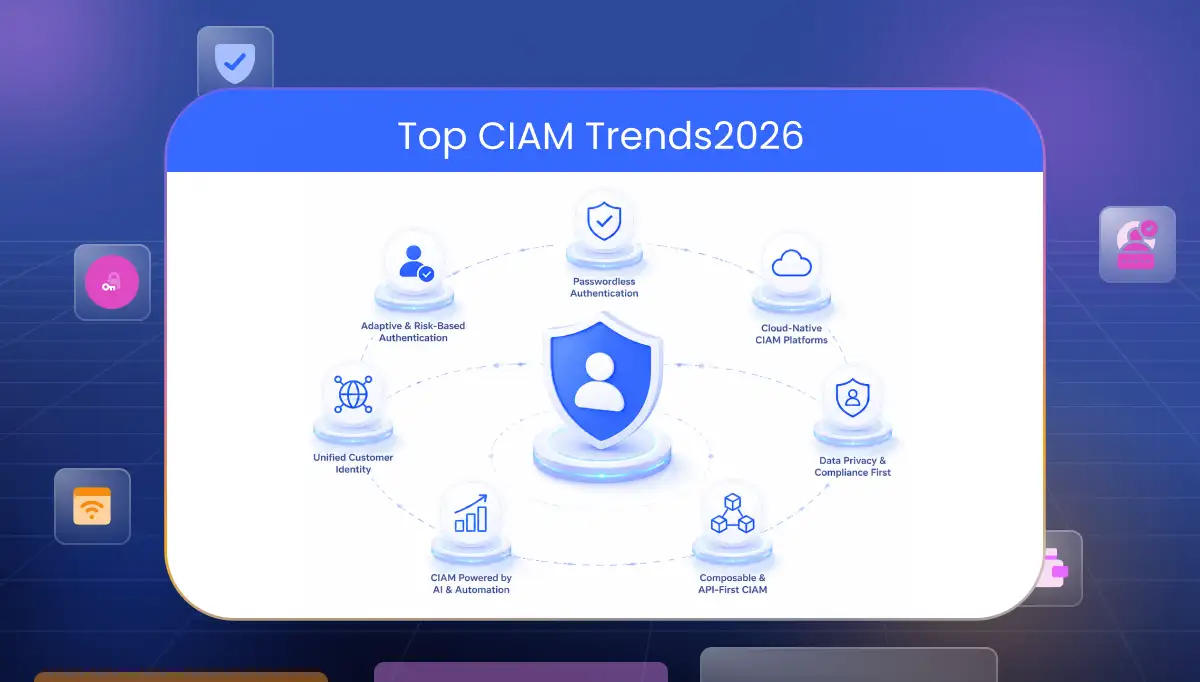

Identity is no longer a background system that only manages login screens. It now influences fraud prevention, customer trust conversion rates and regulatory readiness at the same time. Businesses that treat identity as static are falling behind faster than they realize.
CIAM trends in 2026 show a clear shift toward stronger security, lower friction and smarter architecture. Companies that move early can avoid many problems later and create a better experience for customers over time.
The CIAM Trends Every Business Needs to Watch
Customer expectations have changed quickly. People want instant access, strong protection and a seamless experience across every device and channel. At the same time attackers are using AI automation and more advanced phishing methods.
This is why customer identity management trends now matter to boards product teams and security leaders alike.
Passkeys and FIDO2 Are Now a Requirement
Passwords are becoming harder to defend and harder to justify. They create reset costs, phishing risk and poor user experience. Passkeys built on FIDO2 and WebAuthn are now moving from optional innovation to expected capability. Major platforms including Apple, Google and Microsoft already support them broadly.
Why Passkeys Matter in 2026
As Bojan Simic, Co-Founder and CEO at HYPR, says, people are getting tricked into giving away passwords. Passkeys help fix many of these problems.
- Higher login success. Recent industry reporting shows Microsoft recorded a 98 percent sign in success rate with passkeys compared with 32 percent for passwords. Phishing resistance by design. Passkeys use asymmetric cryptography and domain binding rather than shared passwords. This sharply reduces common phishing attacks.
- Lower support burden. Password resets remain one of the most common support issues. Removing passwords can reduce repetitive customer service costs.
What Businesses Should Do Now
Passkeys should not be treated as an experiment anymore. They should be part of roadmap planning.
- Add passkey options to core journeys. Start with login and account recovery flows where friction is highest. Early wins usually appear there first.
- Measure adoption carefully. Offering passkeys is not enough. Customer prompts device readiness and flow design determine real usage.
- Plan for hybrid periods. Many businesses will run passwords and passkeys together for some time. Good migration matters more than sudden change.
Non-Human Identities Need Their Own Identity Layer
Users are no longer only people. APIs, bots, service accounts, connected devices, and AI agents now request access constantly. Many organizations still secure these identities with tools designed for humans. That gap is becoming dangerous.
Why This Risk Is Growing
Automation has expanded faster than governance.
- Service accounts accumulate. GitGuardian found that 23.7 million new secrets were exposed in public GitHub repositories. Old credentials and unused tokens can remain active for years.
- AI agents need permissions. 73% of organizations expect AI agents to become part of daily operations soon, according to research from the Cloud Security Alliance. These systems need clear access boundaries and accountability.
- Visibility is often weak. Recent reports suggest that non-human identities now outnumber human identities by 50 to 1 in large organizations, creating major blind spots around service accounts, tokens and automated access.
What Modern CIAM Must Include
As technology becomes more independent, identity is no longer only about people. Modern CIAM must protect trust itself because every digital connection now carries risk, responsibility, and human expectation.
- Lifecycle controls. 50% of enterprise IAM programs will manage non-human identities by 2027 as businesses adopt stronger lifecycle controls for machine identities.
- Scoped permissions. Latest Research found that 74% of organizations say AI systems often receive excessive permissions, increasing the need for stricter access control across bots and automated systems.
- Continuous monitoring. Recent industry research shows that 73% of organizations now use AI in cybersecurity operations to improve threat detection and monitor suspicious activity faster.
Deepfakes Are Breaking Traditional Identity Verification
Video selfies, voice checks and document reviews once looked advanced. Deepfake tools are changing that quickly. Fake faces and voices can now imitate real users with alarming realism. Verification methods still work but become much weaker when used alone against modern identity threats.
Why Old Verification Models Are Under Pressure
Attackers no longer need only stolen passwords. They can simulate identity itself.
- Cheap tools are spreading. AI generation tools are more accessible than before. Barriers to misuse have dropped.
- Static checks fail faster. A one time selfie or voice prompt may no longer be enough in higher risk cases.
- Synthetic fraud is scaling. Fraud operations can automate attempts across many accounts at once. Volume changes the threat model.
How CIAM Must Respond
Identity proofing now needs depth not surface checks.
- Liveness and behavioral signals. Movement context device signals and interaction patterns add stronger evidence than static media alone.
- Risk based verification. Higher risk journeys should trigger stronger proofing than low risk journeys. Not every step needs equal friction.
- Layered trust models. No single check should decide everything. Modern identity depends on combined signals.
CIAM and Fraud Detection Are Converging in Real Time
Identity and fraud teams often worked separately in the past. That model is weakening. Fraud signals now need to influence authentication decisions instantly. Login systems are becoming decision engines.
Why This Convergence Matters
Fraud rarely waits for manual review. One of the biggest CIAM trends is the move toward real-time defense because bots, credential stuffing and account takeover attempts now happen at machine speed.
- Authentication without fraud context is blind. A correct password does not always mean a safe login. Credentials are stolen every day.
- Fraud tools without identity context are weaker. Device anomalies matter more when linked to account behavior.
- Speed now decides outcomes. Delayed detection can mean losses within minutes. Real time action matters.
What Businesses Should Build
This is a core part of CIAM modernization in 2026.
- Shared signal layers. Authentication risk engines and fraud systems should exchange context instantly.
- Step up controls. Suspicious sessions should face stronger checks while trusted users stay smooth.
- Unified metrics. Teams should measure fraud reduction and conversion together not separately.
Zero Trust Extends to Customer Identity
Zero Trust began as an internal security model built on one simple principle. Never assume trust and always verify context. That idea is now moving into customer identity because external accounts are frequent attack targets. Modern businesses can no longer treat a successful login as the end of security.
Microsoft explains that Zero Trust principles now extend across identities, devices, applications, networks and data because modern security depends on verifying every layer connected to customer access.
Why Customer Identity Needs Zero Trust
Traditional login models often trust too much after one successful step. Attackers rely on that weakness once credentials are stolen. Continuous trust decisions are becoming necessary.
- Sessions can change after login. A safe login can become risky later through token theft device changes or suspicious behavior. Trust should continue beyond entry.
- Credentials are no longer enough. Passwords or OTP success alone may not prove safe intent. Context now matters as much as identity. Good systems weigh both.
- High value actions need extra proof. Changing payment details, exporting data or resetting security settings may require stronger checks. Sensitive moments deserve stronger trust signals.
What Modern CIAM Should Do
Zero Trust for customers should feel intelligent, not restrictive. Strong protection must still respect user experience because one of the most important CIAM trends is balancing security with frictionless access.
- Continuous risk scoring. Device posture location patterns and behavior can be reviewed during sessions. This helps detect shifting risk in real time.
- Adaptive authentication. Low risk actions remain smooth while unusual actions trigger step up verification. Precision reduces unnecessary friction.
- Granular authorization. Access should be tied to specific actions and sensitivity levels. Not every permission should be permanent.
New Regulations Are Forcing Phishing Resistant Authentication
Regulators and standards bodies are pushing organizations toward stronger authentication. Password only models are increasingly hard to defend in audits and security reviews. Phishing resistant MFA methods such as passkeys hardware backed credentials and FIDO2 are gaining policy momentum. This shift is influencing the wider CIAM market.
Why Compliance Pressure Is Rising
Security failures now create legal reputational and financial consequences. Regulators increasingly expect proven safeguards.
- Password weaknesses are well known. Reused credentials and phishing attacks remain common. Old methods are harder to justify each year.
- Consumer protection is expanding. Many regions are tightening privacy and identity obligations. Strong authentication supports both.
- Board level accountability is growing. Identity failures now reach executive attention quickly. Governance pressure drives modernization.
What Businesses Should Prepare For
Compliance should not be treated as a last minute project. Identity changes require planning.
- Roadmaps for phishing resistant login. Businesses should implement passkeys and strong device bound methods through careful planning now. Waiting creates rushed transitions later.
- Audit ready evidence. Businesses need clear records of authentication controls and policy decisions. Documentation matters.
- Customer friendly rollout plans. Stronger authentication must still feel understandable to users. Adoption depends on communication.
Identity Orchestration Is Becoming the Central Control Layer
Many organizations use multiple identity tools at once while searching for a stronger CIAM solution that can unify them. They may have one system for login, another for fraud, another for verification and others for legacy apps. Identity orchestration is rising because businesses need one layer to coordinate these tools without rebuilding everything.
Why Orchestration Is Growing Fast
Complexity has become expensive. Teams want flexibility without losing control.
- Tool sprawl is common. Businesses often accumulate vendors over time. Orchestration helps them work together more cleanly.
- Journeys need flexibility. Different users channels or risk levels may need different flows. One rigid path no longer fits all.
- Change must be faster. Security teams need to adjust policies without long engineering cycles.
What Orchestration Delivers
One of the clearest CIAM trends in enterprise architecture is the move toward identity systems that continuously balance trust security and seamless user access.
- Central journey control. Signup login recovery and verification flows can be managed in one policy layer. Consistency improves.
- Vendor flexibility. Businesses can swap or add components without replacing the whole stack. Choice creates leverage.
- Faster experimentation. Teams can test flows, controls, and risk models with less disruption. Better systems evolve faster.
Composable CIAM Is Replacing Monolithic Platforms
Large all in one identity suites once looked efficient. Many now feel slow to adapt and difficult to customize. Composable CIAM uses modular services that can be combined based on business needs. This model is gaining momentum as organizations seek agility.
Why Monolithic Models Are Losing Appeal
One platform rarely leads every category at once. Businesses want freedom to choose strengths.
- Innovation cycles differ. Fraud detection, verification analytics and authentication evolve at different speeds.
- Customization matters. Unique customer journeys often need more flexibility than fixed suites provide.
- Migration risk is lower. Modular change allows gradual improvement instead of large disruptive replacements.
What Composable CIAM Enables
- Best of breed stacks. Teams can select stronger components for specific needs. Quality improves through choice.
- Incremental modernization. Legacy systems can be improved piece by piece. This lowers transformation shock.
- Future readiness. Modular architecture adapts more easily as needs change. Flexibility ages well.
Omnichannel Identity Across Every Customer Touchpoint
Customers do not think in channels. They simply expect a brand to know them and serve them consistently. Yet many businesses still separate identity across apps, websites, stores, support desks and partner portals. That fragmentation weakens trust and efficiency.
Why Omnichannel Identity Matters
Identity should travel with the customer not stay trapped in systems.
- Customers expect continuity. Preferences, history and access should feel connected everywhere. Repetition creates frustration.
- Support improves with context. Service teams can help faster when identity is unified. Better context shortens resolution time.
- Brand trust grows through consistency. Organized experiences signal competence. Disconnected experiences suggest neglect.
What Strong Omnichannel Identity Looks Like
- One trusted profile. Customers manage preferences and credentials once across channels. Simplicity builds loyalty.
- Shared consent controls. Privacy choices should follow the user everywhere. Respect must be consistent.
- Connected journeys. A task started on mobile should continue on web or support without restarting. Good identity removes seams and strengthens omnichannel customer journeys.
What These Trends Mean for Your CIAM Strategy
The message across all trends is clear. Identity is becoming a growth system risk system and experience system at the same time. Businesses that treat CIAM as only login technology will move too slowly. Strategy now requires flexibility, intelligence and continuous trust models.
- Prioritize adaptability. Choose platforms that can evolve with regulations, threats and customer expectations. Static systems age quickly.
- Measure business outcomes. Track conversion fraud support cost and trust signals together. Identity affects all of them.
- Plan beyond human users. Customers, bots, APIs and AI agents all need governance now. Scope has expanded.
Is Your Current CIAM Platform Built for What Is Coming
Many platforms were built for an earlier internet. They solved passwords, basic registration and limited channel needs. The next phase demands more. Leaders should test whether their current stack can support passkeys orchestration composability and real time risk decisions.
- Can it reduce friction while increasing security? If not, growth and protection will remain in conflict.
- Can it integrate and adapt quickly? If changes take months the market may move first.
- Can it support future scale? Identity systems should enable expansion not slow it.
For businesses asking these questions, Infisign offers a modern path forward. Its customer identity solutions are built for organizations that need stronger security, faster deployment, and smoother customer experiences without rebuilding everything from scratch.
- UniFed CIAM Platform . Built for customer identity management with passwordless signups, seamless authentication, and infrastructure designed to scale to millions of identities.
- Passwordless Authentication . Supports biometrics, FIDO2 passkeys, OTPs and QR-based login methods that reduce password dependence. FIDO2 and passkeys significantly reduce phishing risk while OTP and QR-based flows still require strong anti-phishing controls.
- Legacy App Compatibility . Enables passwordless access even for older or non standard applications, helping businesses modernize without disruptive migrations.
- Real Time Security Controls . Adaptive MFA, conditional access, brute force protection, and risk aware authentication help stop suspicious activity instantly.
- Fast Integration at Scale . Connects with thousands of applications across cloud, hybrid, and legacy environments through one identity layer.
- Compliance Readiness . Supports audit trails and controls aligned for frameworks such as HIPAA, SOX, and other regulatory needs.
If your current CIAM platform feels slow, fragmented, or outdated, now is the right time to move. Book an Infisign demo and see how a modern identity platform can improve growth, trust, and security together.
FAQs
What is the difference between identity orchestration and a traditional CIAM platform?
Traditional CIAM platforms usually provide built in identity functions inside one product. Identity orchestration acts as a control layer that coordinates multiple tools and services. It gives more flexibility across journeys and vendors.
How does composable CIAM work with a legacy identity system already in place?
Composable CIAM allows businesses to modernize in stages. New modules such as passkeys, fraud tools or orchestration layers can sit alongside legacy systems first. This reduces disruption while capability improves over time.
How do you build an omnichannel identity strategy without replacing your entire stack?
Start by creating a unified identity layer for profiles consent and authentication policies. Then connect existing channels gradually through APIs and shared flows. Most successful programs improve continuity step by step rather than through one large replacement.


