


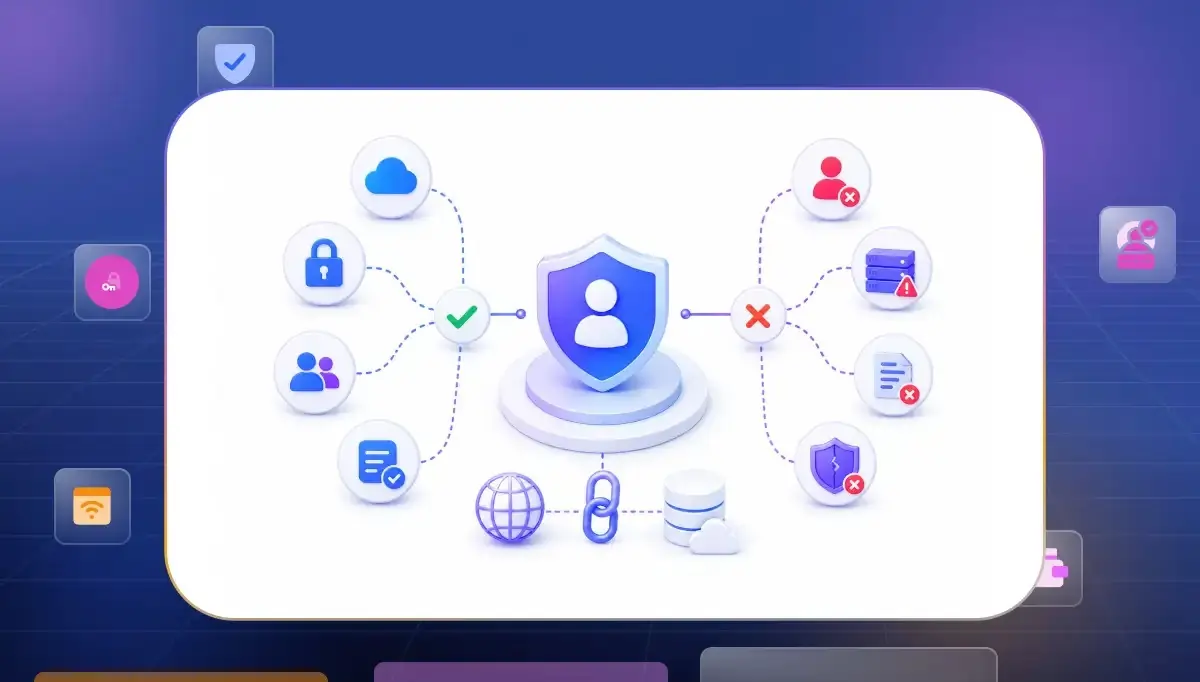

Modern companies no longer run on one application. An employee may open a payroll system in the morning and a cloud dashboard a few minutes later. A customer may log into your SaaS platform while their identity still comes from their own company system. Every login becomes a trust decision between connected environments.
That is why federated identity protocols matter in modern architecture.
Protocols like SAML and OpenID Connect (OIDC) help systems establish trusted user authentication across platforms, while OAuth 2.0 enables delegated authorization between applications and APIs. Some were built for enterprise browser systems. Others work better for APIs and SaaS applications.
Modern identity environments also depend on supporting technologies like LDAP for directory services, SCIM for automated user provisioning, MFA for stronger login security, and adaptive authentication for risk-based access decisions. Many enterprises also apply Zero Trust models where identity verification continues beyond the initial login process.
What Each Federated Identity Protocol Was Actually Built to Handle
Most login systems look simple from the outside. A user signs in and gets access. Underneath that experience, federated identity management helps systems trust users across different environments. Some protocols focus on authentication. Others handle access between systems. Some fit enterprise browser platforms, while others work better for APIs and cloud applications.
Mike Kanakos, Technical Lead in Identity and Access Management and Microsoft MVP, explains that SAML, OAuth, and OIDC were designed for different trust and access scenarios. His analysis highlights how identity problems often emerge when organizations apply the wrong protocol model to modern application architectures.
SAML — Corporate Trust at Scale
Large enterprises adopted SAML because companies needed one trusted login across many internal systems. Before federated login employees often managed separate passwords for HR portals, finance tools and internal dashboards.
SAML solved that problem by creating trust between an Identity Provider and a Service Provider. The Identity Provider verifies the user while the application trusts that verification. The user logs in once and moves between systems without repeating authentication.
SAML became common in enterprise environments because many corporate systems were browser-based and heavily centralized. Among modern federated identity protocols, SAML remains widely used across enterprise workforce environments.
- Enterprise Access. Large organizations use SAML to connect internal applications with centralized identity platforms like Okta, Active Directory or Entra ID. One trusted login reduces password fatigue and simplifies governance.
- Strong Assertions. SAML exchanges XML assertions that carry authentication details, user attributes and trust information. Enterprise systems rely on these signed assertions to validate identity between organizations.
- Compliance Alignment. Many regulated industries adopted SAML because centralized authentication improves audit visibility access reviews and policy enforcement across connected systems.
Where SAML Gets Complicated
SAML was designed during a different internet era. Many modern architectures now depend on APIs, mobile devices, SPAs and cloud-native services that move faster than traditional enterprise systems.
That mismatch creates operational friction across modern identity federation standards.
- Heavy XML Flows. SAML messages rely on XML signatures, certificates redirects and browser sessions. The protocol works well for enterprise browsers but becomes harder to maintain in lightweight modern stacks.
- Mobile Friction. Native mobile applications often struggle with browser redirects, cookie handling and complex federation flows. Teams usually need extra middleware to simplify integration.
- Longer Integrations. Enterprise SAML onboarding often involves metadata exchanges, certificate management, attribute mapping, and manual trust configuration between vendors and customers.
OIDC — Built for Modern Stacks
OIDC was created because modern applications needed a simpler identity layer for web apps, mobile apps, APIs, and cloud services. Instead of XML-heavy assertions OIDC uses lightweight JSON-based tokens that are easier for developers to process.
Many modern login experiences now depend on OIDC even when users never notice it. “Sign in with Google” is one common example.
OIDC works on top of OAuth 2.0 but adds identity verification through ID tokens. OAuth alone only handles delegated access. OIDC adds authentication and user identity claims across modern identity federation protocols.
- Developer Simplicity. JWTs are widely supported across modern frameworks and commonly simplify interoperability in API-driven environments. Cloud-native systems often prefer lightweight token exchanges over XML assertions.
- Modern UX. OIDC works well with SPAs, mobile applications, and API-driven architectures where browser-only assumptions no longer fit the real environment.
- Scalable Federation. SaaS companies use OIDC because onboarding customers into federated login flows becomes faster and more flexible across modern infrastructure.
What OIDC Still Cannot Do
OIDC solves many modern identity problems but it does not automatically replace every enterprise federation requirement. Large organizations still operate older systems that were built around browser-centric SAML trust models and long-standing identity federation standards.
- Legacy Enterprise Support. Many enterprise applications still depend on SAML-only federation workflows. Vendors often support both protocols because customers operate mixed environments.
- Complex Governance. Some regulated organizations maintain older federation controls tied to long-standing SAML integrations, certificates, and policy models.
- Protocol Translation. Many B2B SaaS vendors eventually build federation brokers because customers may require SAML while the product architecture primarily uses OIDC internally.
OAuth 2.0 Handles Access — Not Identity
OAuth 2.0 was built to control access between applications. It does not verify who the user is. It only decides what an application is allowed to access.
For example a photo editing app may ask permission to access your Google Drive files. OAuth handles that permission flow without sharing your password with the application.
That is why OAuth became common in cloud APIs and machine-to-machine communication across modern identity federation protocols.
- Access Delegation. OAuth allows one application to access resources from another system without exposing user credentials.
- API Security. Many APIs use OAuth access tokens to control what applications can read, write, or modify inside a platform
- Limited Identity Support. OAuth tokens show access permissions but they do not confirm the actual identity of the user behind the request.
When OAuth Without OIDC Creates a Security Gap
Many developers mistakenly treat OAuth login as user authentication. That creates risk because OAuth was never designed to prove identity.
Without OIDC the application may know what the user can access but may not fully verify who the user actually is.
- Missing Identity Layer. OAuth handles authorization only. It does not include standardized identity claims for authentication.
- Unsafe Login Flows. Applications using OAuth alone for login can create weak identity validation and session handling problems.
- OIDC Fixes The Gap. OIDC adds ID tokens and user identity claims on top of OAuth so applications can authenticate users correctly.
Where Federation Actually Breaks in Production
Most identity systems look fine at first. Problems usually start after customers connect their own login systems. That is where federated identity management becomes harder. Different systems trust users in different ways, so small mistakes can break authentication across modern federated identity protocols.
James Murphy, Founding Partner at LucasTaylor Consulting Group, recently discussed how modern AI identity governance challenges resemble long-standing federation trust problems, particularly around maintaining governance across heterogeneous environments.
- Session Stability. A user may log in correctly, but the session can fail later between apps and APIs. Expired tokens or logout events often cause these problems.
- Role Mapping. Different companies send user roles differently. Wrong mappings can block users or give the wrong access.
- Certificate Lifecycle. Many enterprise login systems use certificates. If a certificate expires, users may stop logging in completely.
- Protocol Compatibility. Many companies use both SAML and OIDC together because older and newer systems run side by side. Supporting multiple identity federation standards becomes necessary in these environments.
- Legacy Directory Dependencies. Some enterprise environments still rely on LDAP directories to manage internal users and groups. Modern identity systems often need to synchronize federation workflows with older directory infrastructure.
- Provisioning Complexity. Authentication alone does not solve user lifecycle management. Many organizations use SCIM to automate user provisioning and deprovisioning across SaaS platforms and enterprise systems.
- Layered Access Security. Many companies now combine federated login with MFA and adaptive authentication policies. Access decisions may change based on device trust, user behavior, network location, or login risk signals.
How to Evaluate the Federated Identity Protocol for Your Architecture
Every application handles identity differently. The right protocol depends on how the system works. Older enterprise platforms behave differently from modern SaaS applications. Mobile apps, APIs, and cloud services also need different identity flows across modern federated identity protocols.
- System Type. Older browser-based systems often fit SAML better. Modern apps and APIs usually work better with token-based login flows.
- Customer Setup. Large companies already use their own identity providers and security rules. Your product may need to support their existing setup.
- Developer Work. Lightweight token systems are easier to manage in cloud environments. XML-heavy systems usually take more setup time.
- Security Needs. Some companies focus more on governance and centralized access. Others focus more on speed, scalability and modern app support.
Pick the Right Protocol for Your Stack
Enterprise organizations use browser login systems. Modern applications use APIs and cloud platforms more often. Most companies now use both together, so identity systems must keep trust working between different environments across modern identity federation protocols.
- Enterprise Systems. Many company platforms still use SAML because browser login is common in enterprise environments.
- Modern Applications. Many SaaS platforms and CIAM solutions use OIDC because token-based login works better for APIs and mobile apps.
- Hybrid Environments. Many companies use enterprise systems with cloud platforms together. Identity systems must support both sides.
- Future Support. Identity systems stay inside infrastructure for a long time. Flexible federation support helps companies handle future changes more easily.
Infisign helps companies manage SSO and federated identity across enterprise and cloud environments. The platform supports SAML, OAuth, and OIDC authentication flows, making it easier to connect workforce systems, SaaS applications and modern identity infrastructure through one centralized access layer.
Modern identity systems become harder as applications grow. See how Infisign simplifies federation security and access management across enterprise and cloud environments.
FAQs
What's the difference between SSO and federation?
SSO allows users to log in once and access multiple applications without signing in again. Federation works behind that process. It creates trust between different identity systems. That is the core difference between SSO and federated identity in modern access management.
Which protocols are ideal for identity federation?
The right protocol depends on the environment. SAML is still widely used in enterprise identity systems because many workforce platforms depend on browser-based federation. OAuth 2.0 and OIDC are more common in modern applications because they work better across APIs, mobile apps and cloud platforms.
What happens when your B2B SaaS only supports OIDC but enterprise customers use SAML?
This is common in modern SaaS platforms. Many enterprise customers still depend on SAML-based identity systems, while newer SaaS products often use OIDC internally.
To solve this gap, vendors usually add federation brokers or identity gateways that translate trust between both protocols and keep authentication working across different environments.


