


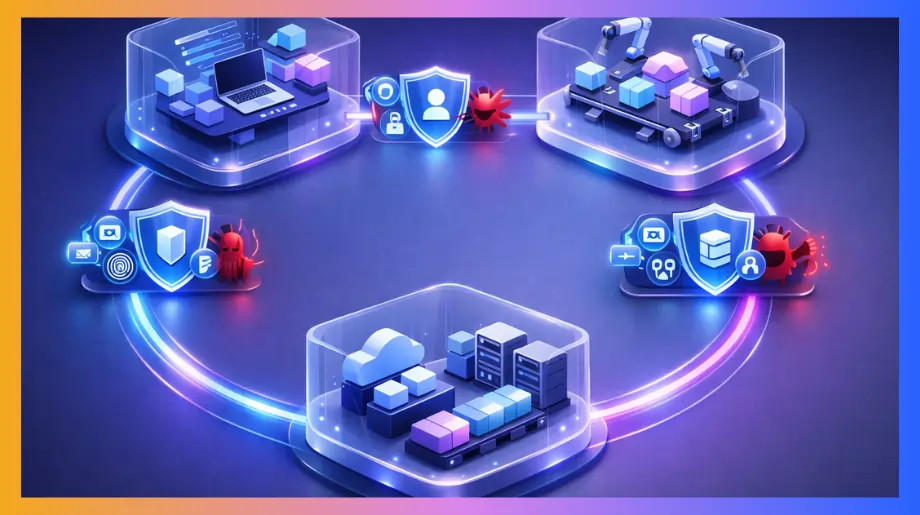

Software supply chains are not as simple as they look because code does not move in a straight line anymore, it passes through tools, vendors, pipelines, and multiple environments before reaching production. Each step adds convenience but each step also adds risk.
Most teams still rely on trust and that is exactly where attackers find their entry. This is why zero-trust principles of software supply chain security matter today because you stop assuming safety and start verifying every single step with clear control.
Why Software Supply Chain Security is Critical in Manufacturing
Manufacturing depends on software but the real risk is unchecked trust where systems accept updates, integrate third party tools and rely on internal networks without deep validation creating a fragile setup where one bad input can affect everything.
When attacks happen they move into operations machines disrupt production slows and downtime hits immediately which makes security critical for business continuity.
Operational Impact
- Production disruption. Manufacturing runs on continuous output. If software is compromised machines can stop or behave unpredictably. Even a small issue can delay production and create financial loss.
- Safety risk. Software controls physical systems. If that control is tampered with it can create unsafe conditions on the factory floor. This makes the impact more serious than typical IT environments.
Trust Breakdown
- Vendor trust misuse. Companies rely on vendors and external tools without full validation. Attackers use these trusted relationships as entry points instead of attacking directly.
- Internal trust assumptions. Systems inside the network are often treated as safe. This assumption no longer works because modern attacks move laterally once inside.
Need for Control
- Access must be restricted. This is where zero trust cybersecurity for manufacturing becomes important. Access is limited to what is actually needed so attackers cannot move freely even if they get in.
- Verification must be continuous. Access and behavior are evaluated based on risk signals and context. They are not trusted after initial authentication. Every action is checked during runtime. This reduces the chance of unnoticed misuse inside the system.
Key Risks in Software Supply Chains That Zero Trust Addresses
Now shift your thinking. This section is not about why it matters. This is about where things break. These are the exact points attackers target inside the software supply chain.
Attackers do not guess. They go after predictable weak spots like dependencies pipelines and access controls. Zero Trust is effective because it directly targets these weak points and limits their impact.
Dependency Risk
- Compromised components. Open source and third party libraries can carry hidden malicious code. Teams often include them without deep validation. Zero Trust controls how components are introduced and used by enforcing strict access and verification. Validation is handled through dependency scanning and integrity checks before any component is used.
- Hidden dependency layers. Many libraries depend on other libraries that are not fully tracked. These hidden layers create blind spots that attackers use to inject code without detection.
Pipeline Risk
- Build tampering. CI/CD pipelines turn code into production output. If attackers gain access here they can modify the final product even if the original code was clean.
- Weak pipeline trust. Pipelines are often treated as safe internal systems. Because of that they lack strict monitoring. Zero Trust reduces implicit trust and introduces verification controls across pipeline stages.
Access Risk
- Excess permissions. Users' tools and services often have more access than needed. Once attackers enter they can move across systems easily. Zero Trust principles in manufacturing environments reduce this risk by limiting access strictly.
- Session level blind spots. Traditional systems stop checking after login. Attackers stay active without being detected. Zero Trust keeps verifying behavior throughout the session.
Vendor Risk
- Compromised partner access. Vendors have direct access for integration and support. If they are breached, attackers use that connection to enter your system.
- Uneven security practices. Not all partners follow strong security standards. One weak vendor can expose the entire chain. Zero Trust enforces the same level of checks across all interactions.
Visibility Risk
- Lack of traceability. Teams often cannot track how code moves from development to deployment. This makes tampering hard to detect.
- Delayed detection. Supply chain attacks look like normal activity because they use trusted paths. Zero Trust improves monitoring and helps catch issues early.
Core Zero Trust Principles Applied to Software Supply Chains
Software supply chains become secure when trust is replaced with control at every step. Zero Trust is not a tool here. It is a set of rules applied across development build and deployment. Every stage is treated as a potential risk point. Nothing is assumed safe by default.
The idea is simple but strict. Verify everything. Limit access. Monitor continuously. That is how zero trust in the software supply chain moves from concept to real practice.
- Strict component validation. Every dependency library and external package is verified before use. Teams do not assume that open source or vendor code is safe. Each component is checked for integrity and origin. This reduces the chance of hidden malicious code entering the system.
- Least privilege access. Access is limited for users tools and services across the pipeline. No system gets full control unless it is absolutely required. If one part is compromised it cannot move freely. This keeps the impact small and contained.
- Continuous verification. Trust is not given once at login. Systems keep checking behavior during runtime. If something unusual happens it gets flagged immediately. This helps detect issues before they turn into full attacks.
- Secure pipeline enforcement. CI/CD pipelines are treated as critical assets not trusted zones. Every stage from code commit to deployment is monitored and verified. Changes cannot move forward without validation. This prevents tampering during the build process.
- End to end visibility. Teams maintain clear visibility of how code moves across the supply chain. Every action is logged and traceable. This makes it easier to detect anomalies and respond quickly when something goes wrong.
How to Start Applying Zero Trust to Your Software Supply Chain
Applying Zero Trust is not a one time setup. It is a structured shift in how access and trust are handled across the supply chain. The right way to begin is not with tools but with clarity. You first understand identities then control access then secure pipelines and finally build continuous monitoring.
The goal is simple. Know who or what is interacting with your systems. Verify every request. Limit what each entity can do. Keep checking behavior over time. When done step by step this approach builds strong control without breaking workflows.
Step 1: Map Your Supply Chain Identities
- Identify all entities. Start by listing every user service application and pipeline that interacts with your system. Without clear identity mapping Zero Trust cannot work. Every entity must be known and tracked.
- Understand relationships. Go beyond listing and map how these entities interact. Identify which systems talk to each other and what level of access is used. This creates a clear picture of your supply chain structure.
Step 2: Enforce Strong Authentication & Identity Governance
- Strengthen authentication. Use multi factor authentication for critical systems and services. Credentials alone are not enough. Additional verification layers reduce the risk of unauthorized access.
- Manage identity lifecycle. Control how identities are created, updated and removed. Old or unused accounts should not remain active. Proper governance reduces long term risk.
Step 3: Implement Least Privilege Access Controls
- Limit access scope. Every user and service should get only the access required for their role. Avoid broad permissions that allow unnecessary movement across systems.
- Segment access paths. Separate systems and restrict how entities move between them. Even if one part is compromised the attacker cannot access everything.
Step 4: Secure CI/CD Pipelines and Code Integrity
- Protect build pipelines. Treat pipelines as critical assets. Restrict who can modify them and monitor all activity closely. Pipelines should not be assumed safe by default.
- Validate code integrity. Ensure that code and dependencies are verified before deployment. Signed artifacts and integrity checks help confirm that nothing has been altered.
Step 5: Monitor and Continuously Validate Access
- Track behavior continuously. Monitor how users and systems behave during operation. Look for unusual patterns that may indicate compromise.
- Respond in real time. Do not wait for incidents to escalate. Continuous validation allows early detection and faster response which limits overall impact.
Challenges in Implementing Zero Trust in Supply Chain Environments
Zero Trust sounds clean in theory but implementation gets complicated very quickly. Supply chains are already complex with multiple vendors, legacy systems and fast moving pipelines. When you try to enforce strict verification and access control across all layers friction starts to appear.
- Legacy system gaps. Many manufacturing systems were not built for modern security models. They lack support for strong authentication or fine grained access control. Replacing them is expensive and modifying them is risky so teams end up working around them.
- Complex architecture. Supply chains include dependencies pipelines vendors and cloud services all connected together. Applying consistent Zero Trust controls across all these layers requires deep understanding and careful planning. Without that it becomes fragmented.
- Limited visibility. Teams often do not have a full view of how code and data move across the supply chain. Hidden dependencies and indirect interactions create blind spots. Without visibility enforcing Zero Trust becomes guesswork.
- Vendor dependency risk. External partners have different security standards and practices. Some may not support strict identity and access controls. This makes it difficult to apply consistent policies across the entire chain.
- Operational friction. Strict verification and access controls can slow down workflows if not designed carefully. Developers and operations teams may resist changes that impact speed and productivity.
- Cost and skill constraints. Implementing Zero Trust requires investment in tools, training and process changes. Not every organization has the resources or expertise to execute it properly which leads to partial adoption.
Identity and Security Tools That Support Zero Trust in Software Supply Chains
At this stage the focus is execution across the software supply chain. Tools are not just for blocking threats. They are used to control how code moves, how access is granted and how pipelines behave.
Strong Zero Trust tools focus on identity validation dependency control pipeline security and continuous monitoring. These areas directly map to real supply chain risks like compromised libraries, pipeline tampering and unauthorized access.
1. Infisign
Infisign operates as an identity focused access control layer across the software supply chain. It verifies developers services and vendors before granting access to code repositories and pipelines, which helps reduce the risk of unauthorized changes.
Key Features
- Identity-Centric Access Control. Developer service and pipeline interactions are linked to verified identities. This helps ensure that only authenticated entities can perform actions within the supply chain.
- Granular and Conditional Access Policies. Access to repositories pipelines and environments is governed by role context and behavior, which helps limit unnecessary permissions and reduce exposure.
- Vendor and Third-Party Access Management. External contributors and vendors are restricted to defined systems and actions. This helps control third party access and reduces potential entry points.
- Zero Trust Architecture Support. Requests across development and deployment are continuously verified, ensuring that no user or system is trusted by default.
- Audit Logs and Compliance Visibility. Actions across repositories pipelines and environments are logged, providing traceability for access and changes.
- Multi-Cloud and Multi-Environment Compatibility. The system operates across cloud and hybrid environments, helping maintain consistent controls across distributed setups.
2. Microsoft Entra ID
Microsoft Entra ID secures identity across developers services and cloud environments. It plays a key role in controlling who can access repositories, pipelines and deployment systems. It is especially useful in hybrid environments.
Key Features
- Conditional Access Policies. Access to code repositories and build systems is granted based on user risk device state and context. This prevents risky access attempts from reaching critical systems. It strengthens control over supply chain entry points.
- Multi Factor Authentication. Developers and administrators must verify identity before accessing pipelines or making changes. This reduces the risk of credential based attacks entering the supply chain. It adds a strong layer at access points.
- Identity Protection. Suspicious login behavior is detected and blocked before access is granted. This prevents compromised accounts from injecting malicious code or modifying builds. It protects development and deployment stages.
- Privileged Identity Management. High level access to production or deployment systems is tightly controlled and time bound. This reduces the risk of misuse of critical permissions. It ensures sensitive actions are monitored and limited.
3. Okta
Okta focuses on identity driven access control across applications and development environments. It helps secure access to tools that are part of the software supply chain like repositories CI systems and APIs.
Key Features
- Single Sign On. Developers access multiple tools through one controlled identity layer. This centralizes access control and reduces unmanaged entry points. It helps maintain consistency across the supply chain.
- Adaptive Multi Factor Authentication. Authentication strength changes based on risk level and behavior. High risk actions like code pushes or pipeline changes require stronger verification. This protects critical operations.
- Lifecycle Management. User access is managed from onboarding to removal across all systems. Old or unused accounts are removed quickly. This reduces the risk of dormant accounts being exploited.
- API Access Management. APIs used in pipelines and integrations are secured with strict identity checks. Only authorized systems can interact with them. This protects automated processes in the supply chain.
4. Palo Alto Networks Prisma Cloud
Prisma Cloud focuses on securing cloud workloads and CI/CD pipelines. It provides visibility and control across development build and runtime stages. It is useful for detecting risks early and maintaining integrity after deployment.
Key Features
- Cloud Workload Protection. Deployed applications are monitored for abnormal behavior during runtime. This helps detect if compromised code is executing in production. It protects the final stage of the supply chain.
- Infrastructure as Code Scanning. Infrastructure definitions are scanned before deployment. Misconfigurations and vulnerabilities are identified early. This prevents insecure environments from being created.
- Runtime Protection. Active environments are continuously monitored for suspicious activity. Immediate response helps contain threats quickly. This limits the impact of compromised components.
- Compliance Monitoring. Systems are checked against security policies and standards. This ensures that supply chain processes follow required controls. It helps maintain consistent security posture.
5. Snyk
Snyk focuses directly on developer workflows and dependency security. It is designed to catch vulnerabilities before they reach production. It plays a critical role in securing the earliest stages of the software supply chain.
Key Features
- Open Source Dependency Scanning. Dependencies are scanned for known vulnerabilities before integration. This prevents risky libraries from entering the codebase. It directly addresses one of the biggest supply chain risks.
- Container Security. Containers are analyzed before deployment to detect vulnerabilities. This ensures that packaged applications are secure before release. It protects deployment integrity.
- Code Analysis. Application code is analyzed during development to identify security issues. Developers can fix problems early before they move into later stages. This reduces downstream risk.
- Vulnerability Prioritization. Issues are ranked based on severity and impact. Teams focus on fixing critical vulnerabilities first. This improves response efficiency across the supply chain.
What to Look for in Zero Trust Security Solutions for Supply Chains
At this point you are not just learning concepts. You are deciding what actually works in a real setup. Every tool will claim Zero Trust but not every tool will fit your supply chain. You need something that understands how code moves, how teams interact and how pipelines behave.
So instead of getting impressed by features you should think in a simple way. Will this tool control access properly? Will this tool show what is happening inside the system? Will this tool stop bad changes from reaching production. If the answer is yes then you are on the right track.
- Identity assurance. Every user service and system should be verified before access is allowed. You should always know who is interacting with your repositories or pipelines. If identity is weak then everything else becomes weak.
- Granular access control. Not everyone needs full access and that is where most systems fail. A good solution limits what each user or service can do. You reduce risk without breaking workflows.
- Continuous monitoring. Trusting everything after login is risky. Activity should be tracked continuously during usage. You should be able to detect unusual behavior before it turns into a real problem.
- Dependency validation. Open source libraries are useful but they can introduce risk. A strong solution checks every dependency before it becomes part of your system. You stop issues at the earliest stage.
- Pipeline security. CI/CD pipelines are where code moves into production. If control is weak at this stage everything becomes vulnerable. You need strict validation before any change is deployed.
- Vendor control. Giving full access to external partners may feel convenient but it creates risk. A good solution keeps their access limited and monitored. You stay in control even when third parties are involved.
- End to end visibility. You should clearly see what is happening across your system. Every action should be traceable so investigation becomes easier. You cannot protect what you cannot see.
- Cross environment support. Systems are spread across cloud on premise and hybrid setups. A solution should work consistently across all environments. This ensures there are no hidden gaps in security.
Strengthen Your Software Supply Chain Security with Zero Trust
Software supply chains fail when trust is assumed instead of verified, and Zero Trust fixes this by removing blind access and enforcing control at every step. The focus is simple, verify every request, limit access and monitor continuously.
Strong security does not come from one tool. It comes from combining identity control access restriction and pipeline security into one system. When these layers work together, risk reduces and visibility improves without slowing development.
Zero Trust should fit how your systems actually operate, and it should connect identities pipelines and environments without adding unnecessary friction.
H3: Building a Practical Zero Trust Layer for Modern Supply Chains
A practical approach starts with identity, where every user service and vendor is verified before access is allowed and access changes based on role behavior and context. Vendor access is restricted and monitored so it never becomes an open path into the system, and all actions across pipelines and environments are tracked to maintain visibility.
Security should also remain consistent across cloud and hybrid environments, so there are no gaps. When these elements come together, you get a system where access is controlled behavior is monitored and risks are contained early.
- Identity driven access control across users, services and pipeline interactions
- Context aware policies enforce access based on behavior, role and risk
- Controlled vendor access prevents unauthorized movement across internal systems
- Continuous verification ensures every request is validated before granting access
- Detailed audit logs provide full visibility into actions across environments
- Multi environment compatibility supports cloud hybrid and distributed infrastructure securely
You have seen the risks and you know what needs to change. Now take the next step. Book a demo and see how you can secure your supply chain without slowing your team down.
FAQs
How does Zero Trust protect against supply chain attacks?
Zero Trust blocks supply chain attacks by verifying every user service and request. It limits access strictly and monitors behavior continuously. Even if attackers enter they cannot move freely or spread damage.
What is the cost of implementing Zero Trust for software supply chain security?
Costs depend on tools integration and team readiness. Initial setup may require investment in identity systems training and process changes. Over time reduced breach risk and faster detection balance the overall cost.
How does Zero Trust apply to third-party vendor access?
Zero Trust restricts vendor access based on role and need. Vendors get limited permissions and continuous monitoring ensures their actions stay controlled. This prevents misuse and reduces risk from compromised external partners.


