



Enterprise security is trapped in a cycle of building taller walls around fragile databases. We have spent decades treating identity like a liability that must be locked in a vault but that approach is failing as data demands grow. Real strength comes from verifying facts without needing to hoard the raw data yourself.
This is the shift toward decentralized identity solutions that now separates companies stuck in the past from those that are building a more secure and sustainable future for their users.
What Separates a Real Decentralized Identity Solution From an Add On
Many people just add a small extra layer to their old system and call it decentralized identity but there is a huge difference between a real solution and a simple patch. If you want your security to be ready for the future you need to see what makes a tool part of the best decentralized identity solutions instead of just a quick fix.
- Architecture. A decentralized identity solution is designed around standards such as W3C Decentralized Identifiers (DIDs) and Verifiable Credentials (VCs). This enables cryptographic verification of identity while reducing reliance on centralized identity stores. Many enterprise deployments use hybrid architectures that combine decentralized and traditional identity systems, allowing for a secure transition that bridges modern verifiable proofs with existing infrastructure.
- Interoperability. A strong decentralized identity platform supports widely adopted standards such as W3C Decentralized Identifiers, W3C Verifiable Credentials, and relevant OpenID Foundation specifications to maximize interoperability across ecosystems. This ensures your identity data remains portable and functional across different systems rather than being trapped in a single provider's proprietary environment.
- True Ownership. Many decentralized identity solutions allow users to control credentials through digital wallets, although some enterprise deployments also support managed or custodial wallets depending on organizational requirements. This balance allows businesses to meet compliance needs while still moving away from the risks associated with storing all user passwords in a single central vault.
What Enterprise Ready Decentralized Identity Actually Requires
Moving your business to a new way of handling identity is a big step that goes way beyond basic software updates. You are not just changing how people log in but creating a fresh way to build trust across your entire company.
Modern cybersecurity requires a proactive approach where protecting data is a core business continuity necessity rather than just an IT concern. Executives must prioritize integrated risk management and cross-industry intelligence sharing to maintain the market confidence essential for success, as noted in the Navigating The Digital Age guide.
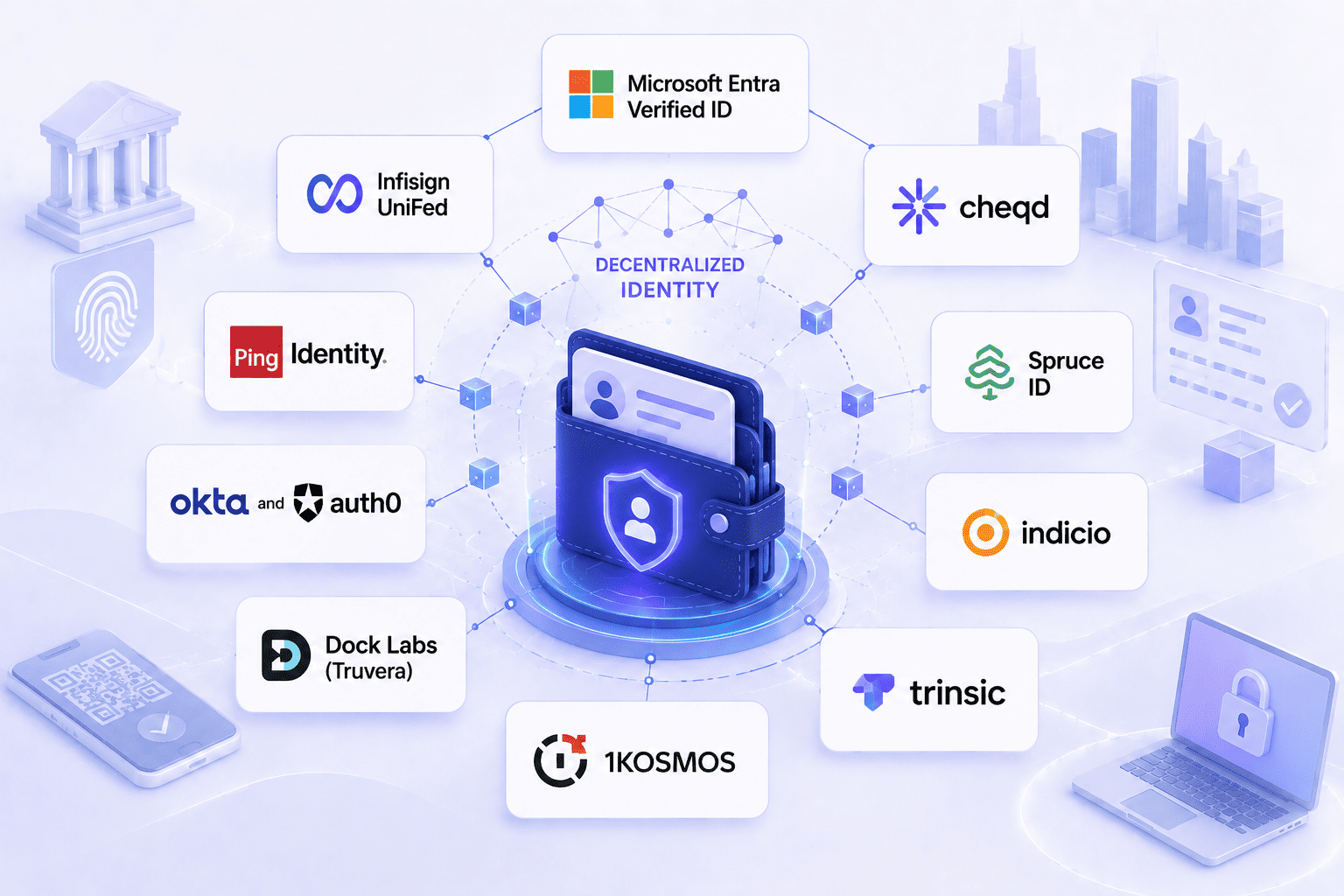
The following platforms provide capabilities that can help organizations adopt decentralized identity while integrating with existing enterprise infrastructure through phased deployment.
1. Microsoft Entra Verified ID
This solution integrates directly into the Microsoft ecosystem so your IT team can manage digital credentials alongside their existing user accounts. It is ideal for organizations that want to use decentralized identity without leaving their familiar Azure workspace.
Key Features
- Credential Lifecycle Management. Automates the issuance and revocation of digital cards so your team saves time on manual updates.
- Interoperability Standards. Supports W3C Decentralized Identifiers and Verifiable Credentials, along with interoperability work from the Decentralized Identity Foundation and OpenID Foundation.
- Privacy Preserving Verification. Allows users to prove attributes—like their job role—without sharing their full identity profile.
Pros
- Connects with your current Windows and Azure directory.
- Backed by enterprise-grade security and long-term support.
Cons
- It can be difficult to configure if you do not have existing Microsoft infrastructure.
- Pricing is often bundled into complex enterprise licenses.
2. Infisign UniFed
Infisign uses a zero trust model for identity protection. This makes it simple to lock down access points instead of keeping risky password lists. It works like a link that connects your old systems with new digital identity wallets.
Key Features
- Zero Trust Passwordless Auth. Uses continuous, context-aware checks to verify identity instead of static passwords.
- Reusable Identities. Reusable identities may be supported depending on deployment architecture. Confirm current decentralized credential capabilities with the vendor.
- Automated Lifecycle Management. Uses smart workflows to provision and de-provision user access across all your apps automatically.
Pros
- Great for companies looking to move to a clean zero-trust security model.
- Clean, user-friendly interface that simplifies complex identity tasks.
Cons
- Documentation is still growing and can be sparse for advanced custom use cases.
- Requires a solid understanding of your internal app permissions before setup.
3. Ping Identity
PingIdentity offers identity services including authentication, authorization, orchestration, and decentralized identity capabilities across parts of its platform. It is a powerful orchestrator for large companies that need to manage millions of identity interactions reliably.
Key Features
- Identity Orchestration. Provides a drag-and-drop workflow to manage how identities are verified and shared across your apps.
- Unified Admin Portal. Ping Identity provides centralized administration for multiple identity services. Support for decentralized credentials depends on the deployed products and configuration.
- API Security. Ensures that every credential check is verified against the source to prevent account takeovers.
Pros
- Proven performance at the scale of global enterprises.
- Highly customizable to fit strict industry compliance needs.
Cons
- Requires a higher investment and expert help to set up correctly.
- The large number of features can feel complex for smaller teams.
4. Okta and Auth0
Okta and Auth0 help companies add identity tools to apps quickly. They work well for teams that want to build fast. Businesses choose them when they need a reliable way to handle logins without building everything from scratch.
Key Features
- Identity Federation. Supports industry-standard federation protocols such as OpenID Connect, OAuth 2.0, and SAML. Verify decentralized identity integrations based on your implementation requirements.
- Smart Wallet Deployment. Custom wallet integration may be possible through application development or partner solutions, depending on deployment architecture.
- Privacy Preserving Proofs. Supports modern login flows where users can authenticate without exposing their underlying private data.
Pros
- Massive library of pre-built integrations for thousands of common apps.
- Excellent tools and SDKs that let your developers ship faster.
Cons
- Costs can rise quickly as your user volume grows.
- Decentralized identity is an add-on module rather than the core of their original architecture.
5. Dock Labs (Truvera)
Truvera provides a simple way to create and manage digital IDs. It abstracts much of the underlying decentralized infrastructure, allowing organizations to issue and verify credentials without directly managing the supporting network. You can issue and verify user information while keeping the process easy for everyone.
Key Features
- Zero Knowledge Proofs. Allows users to verify information like "I am over 18" without revealing their birth date or name.
- Wallet SDK. Gives you the code needed to build a wallet inside your existing software products.
- Instant Verification. Uses simple QR code scanning to confirm the authenticity of any credential in real-time.
Pros
- Zero blockchain expertise needed for your team to get started.
- Highly flexible API that works with most modern programming languages.
Cons
- The system works best when you have a network of partners to accept your credentials.
- Not a traditional "turnkey" product, so you need to do some custom building.
6. 1Kosmos
1Kosmos Verify uses biometrics and document scanning to confirm who people are. It removes the need for passwords by using secure digital identity tools instead. This makes it a strong choice for banks and other high security fields where proving identity is very important.
Key Features
- Biometric Binding. Ties a person’s real-world identity to their digital wallet using live face and fingerprint scanning.
- Portable Identity Wallets. Identity wallets can reduce the amount of personal information stored centrally by enabling users to present verified credentials when appropriate.
- Seamless Onboarding. Automates the process of checking ID documents during sign-up to reduce friction.
Pros
- Significant reduction in phishing and account takeovers.
- Simplifies regulatory compliance by reducing unnecessary centralized storage of identity data, depending on deployment and regulatory requirements.
Cons
- Setup can be complex due to the strict biometric requirements.
- Users might need guidance the first time they use the liveness-check feature.
7. Trinsic
Trinsic offers infrastructure that allows organizations to issue digital credentials without needing to manage the underlying network layers. It is a highly scalable solution for businesses that want to build their own custom trust networks.
Key Features
- Credential Issuance API. A straightforward API that lets you create and send digital IDs to any wallet.
- Interoperable Standards. Built around W3C Verifiable Credentials and Decentralized Identifiers, with support for evolving OpenID Foundation specifications.
- Ecosystem Governance. Includes tools to manage which issuers and verifiers are trusted within your business group.
Pros
- Incredibly fast performance even when handling many requests.
- Excellent developer documentation and support.
Cons
- You are responsible for defining the trust rules within your ecosystem.
- Less "out-of-the-box" support for legacy enterprise applications.
8. Spruce ID
Spruce ID leads the way in open source identity tools. They keep identity portable and under the control of the user. Organizations choose them to build on neutral technology without being stuck with one vendor.
Key Features
- Open Source Infrastructure. Every component is auditable and transparent, which is great for security and trust.
- Data Portability. Ensures users can take their identity credentials across different apps and platforms easily.
- Cross Domain Auth. Supports interoperable credential verification across applications that adopt compatible decentralized identity standards.
Pros
- No vendor lock-in because the standards are purely open.
- High level of trust within the developer community.
Cons
- Requires more in-house engineering work to build a polished enterprise solution.
- Lacks the extensive management dashboards found in platforms like Microsoft or Ping.
9. Cheqd
Cheqd is a network layer that provides the economic and technical foundation for identity ecosystems. It is best suited for organizations that want to create a marketplace or a network where issuing and verifying credentials happens commercially.
Key Features
- Payment Rails. Supports payment infrastructure that enables organizations to build commercial credential ecosystems where credential-related services can be monetized.
- Network Governance. Provides a structured way to manage compliance rules across many different partners.
- Secure Credential Exchange. Uses robust encryption to ensure that identity claims are not tampered with during the transfer.
Pros
- Unique ability to turn identity verification into a sustainable revenue model.
- Designed to be a foundational layer rather than just an app.
Cons
- Requires a good understanding of network-based identity models.
- It is not a "plug-and-play" login system for everyday apps.
10. Indicio
Indicio focuses on building large-scale trust ecosystems, particularly for government and high-stakes enterprise use cases. Their platform uses cryptographic verification to help reduce identity fraud while improving trust in credential exchanges.
Key Features
- Agentic AI Verification. If AI-agent identity capabilities are required, verify current support directly with Indicio, as this capability is not broadly documented.
- Interoperable Biometrics. Integrates with leading biometric tech for high-assurance identity binding.
- Data Integrity. Uses advanced proofs to ensure that shared information remains untampered and verified.
Pros
- Proven at the national/government scale for security.
- Comprehensive approach that covers everything from issuance to governance.
Cons
- Primarily built for large-scale, complex projects rather than simple business use cases.
- Requires a deep architecture plan before implementation.
Best Decentralized Identity Fabric Solutions
An identity fabric is an architectural approach that integrates identity services across directories, applications, authentication systems, governance platforms, and, where appropriate, decentralized identity components. This setup keeps your tech setup flexible so you can add new security tools whenever you need them.
- Unified Control Plane. This layer links your traditional cloud directories with modern digital wallets to ensure a smooth flow of data across your entire tech stack.
- Consistent Policy Enforcement. It provides a single way to handle user permissions so you do not have to update settings in every single app whenever someone changes their role.
- Real Time Visibility. You get a single dashboard that keeps an eye on all security traffic which helps you spot potential risks before they become real problems.
Switching From Centralized to Decentralized Identity Without Breaking What Works
You do not have to throw away your current setup to start using modern identity tools. The smartest way to move forward is to build a bridge that lets your old and new systems work together. By focusing on specific tasks like verifying employee certifications or customer access tokens, you can test the new model in small areas first to ensure stability.
Building a truly decentralized identity is a complex challenge, requiring a secure, private, and portable system that remains user-friendly and Sybil-resistant, ultimately empowering individuals to reclaim control over their personal data, as discussed in recent community threads on Reddit.
- Phased Implementation. You can start by issuing digital credentials for just one team or one specific task while keeping your main login system for everything else.
- Parallel Infrastructure. Many organizations use hybrid identity architectures that allow centralized and decentralized identity systems to operate together during migration.
- Risk Based Transitioning. By phasing in decentralized verification for low risk tasks first your IT team learns how to manage the new tools without facing the pressure of a total system overhaul.
Which Decentralized Identity Solution Should You Actually Pick
You should look at how much control you want over your data versus how much time your team can spend on building custom tools. It comes down to finding a balance between making things easy for users while staying tough against attackers.
Moving to decentralized identity is a long-term investment in trust and data security rather than a quick fix. Success relies on choosing tools that fit your existing infrastructure while allowing for growth as global standards evolve.
Start by auditing your current identity hurdles and then pick a platform that bridges your legacy gaps without trapping you in a new silo. When you prioritize interoperability and user privacy today you build a foundation that remains resilient against changing security threats.
This approach turns identity from a simple login process into a powerful asset that simplifies your operations and protects your organization from evolving digital risks.
Infisign UniFed is one tool that fits into existing setups by acting as a connective layer between legacy systems and new digital identity standards.
- Infisign supports Zero Trust identity principles and you should verify the availability of continuous context and device posture evaluation based on the product edition and deployment.
- The platform supports identity management capabilities, while reusable decentralized credentials should be confirmed with the vendor.
- It automates the lifecycle of user permissions so that access is granted or removed based on the latest company data rather than manual entries.
Modernize your enterprise security now. Bridge the gap to a secure, flexible future with Infisign UniFed and see how it works for your team. Book your personal demo right here.
FAQ
Q1: What are decentralized identity solutions?
Many decentralized identity solutions allow users to control digital credentials through identity wallets, while some enterprise deployments also support managed or custodial wallets.
Q2:What is the most recommended decentralized identity solution?
The best choice depends on your current setup as Microsoft Entra Verified ID is a strong option for organizations already invested in the Microsoft identity ecosystem, while Infisign UniFed is recommended for teams needing a bridge between legacy and modern identity.
Q3: What are the best alternatives to a decentralized identity solution you already use?
If you rely on standard SSO, consider platforms like Ping Identity or 1Kosmos. These add decentralized verification layers to your existing workflow, giving you modern security without replacing your entire tech stack.
Q4: How do you switch from centralized to decentralized identity?
Start by picking one small process, like internal employee onboarding. Use a fabric layer to verify credentials in parallel with your old system, then slowly move more services over as you gain confidence.


