


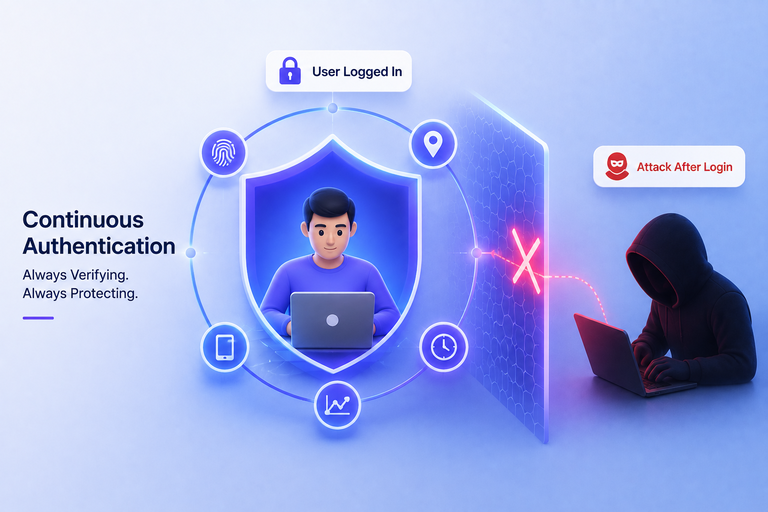

In modern enterprise security the network perimeter is gone. The old castle and moat approach which relies on checking identity just once at the door is failing against attackers who steal login sessions and tokens.
Once you prove who you are, traditional systems give you long lasting access. This creates a massive blind spot that hackers use to move freely inside the network. This guide looks at how continuous authentication can strengthen security after login and how to implement it effectively.
Your Login Check Passed and the Attacker Still Got In
Some authentication systems rely heavily on the initial login and relatively long-lived sessions, which can increase the window in which a stolen session credential may be misused. Yet hackers still break in minutes after getting a real access pass by stealing active browser cookies with malware.
This security gap is one reason organizations are adopting continuous access evaluation, which can help systems respond to changes in identity, device, session, and security conditions during an active session.
- Stolen Passes. Attackers grab active session cookies using malware to bypass perimeter defenses completely. They slip past initial checks because the stolen ticket looks entirely real.
- Hidden Movement. Adversaries move freely across cloud apps once inside an open session. They grab private customer lists while security monitoring tools remain completely blind to the threat.
- Failed Timing. Waiting for routine login screens to catch a thief does not work. Sessions stay open for hours while modern threats strike in a matter of seconds.
- Constant Checks. Security must move beyond simple gatekeeping to continuous risk based authentication. Security controls can continuously or periodically evaluate relevant signals and respond when risk or security conditions change.
What Continuous Authentication Means Beyond the Vendor Definition
Marketing brochures from identity vendors often reduce ongoing security to a simple re-authentication prompt. If a user tries to access a sensitive database the system pops up a push notification asking for biometric confirmation.
Step-up authentication provides an extra layer of security when risk increases, though poorly managed prompts can add unnecessary user friction. Continuous verification can evaluate background signals to assess risk and may trigger additional authentication or other security controls when risk increases.
The Core Feedback Loop
The security definition relies on a continuous feedback loop between the user, the device and the application. Systems evaluate risk factors constantly instead of checking identity just once per day.
- Behavioral Analysis. The platform tracks typing cadence and mouse movement patterns to spot anomalies. If an automated script or attacker changes normal user patterns, behavioral signals can spot the anomaly and trigger immediate security controls.
- Sliding Trust Scale. Access functions as a sliding scale rather than a binary switch. Sessions start with high trust based on standard checks while the system updates a risk score continuously.
- Score Drifts. Organizations can configure policies to respond to elevated risk signals by requiring additional authentication, restricting access, or revoking sessions.
- Real Time Adaptation. Applications adapt to shifting threat levels instantly so users work uninterrupted while high risk triggers automated defense responses.
The Signals That Tell You a Session Has Gone Bad
Catching a hacked login session takes more than just looking at IP addresses or browser details. Smart attackers easily hide their tracks by routing traffic through normal looking proxy networks. Security systems need to study user habits and device details to understand what continuous authentication is in everyday tech environments.
Behavioral and Device Signals
Modern security tools look closely at everyday habits and hardware details to catch hidden attackers right away.
- Typing Biometrics. Security tools watch how fast you type and move your mouse. This helps the system make sure a real person is active instead of a robotic script.
- Hardware Attestations. If your stolen login cookie gets used on an unknown laptop missing proper security checks, your trust score drops right away. Systems block access before damage happens.
- Network Velocity. When an active session appears to originate from geographically distant locations within an implausibly short period, an identity platform flags the activity as an anomaly and uses it as a key signal in risk evaluation.
Intent and Context
Evaluating how you interact with apps and files helps systems catch strange actions mid way through a session using zero trust continuous authentication.
- Interaction Patterns. Normal users almost never download thousands of customer files late at night. When an open session suddenly tries to open locked folders, the system treats it as hostile.
- Endpoint Health. If background security apps notice that your local disk protection turns off or firewalls drop mid session, your trust score falls fast. The system steps in to protect your data.
- Combined Streams. Combining multiple signals can give security teams more context about session risk and support earlier detection and response to suspicious activity.
How Access Actually Gets Revoked Mid Session
Revoking access instantly during an active session is surprisingly difficult in old web systems. Traditional setups rely on long-lived passes stored right inside your browser.
In some token-based architectures, access can remain available until a token expires unless additional mechanisms are implemented to detect and respond to changes in session or authorization state. If an admin clicks a block on their dashboard, the attacker keeps working until the pass expires on its own.
- Short Passes. Modern systems use quick expiring passes combined with regular background checks. Depending on the architecture, applications can use token validation, introspection, event-based signaling, or other mechanisms to respond when access should be revoked.
- Blacklist Checks. When risk increases or an administrator revokes access, supported systems can use mechanisms such as session revocation, token invalidation, policy enforcement, or security-event signaling to restrict further access.
- Live Sockets. Depending on the architecture, systems can use event-driven signaling, API calls, token validation, or other mechanisms to communicate changes in security and access conditions.
Where Continuous Authentication Breaks in Real Deployments
Deploying real time session checks across a large company brings major engineering hurdles. The biggest challenge is finding the right balance between strict security and keeping work fast. If security rules are too sensitive, regular employees get locked out constantly just because of a slow internet connection or a quick trip. False alarms destroy trust and force teams to turn off strict rules under pressure.
- False Lockouts. Overly sensitive security rules block real users due to minor network hiccups or unusual travel patterns. This friction destroys trust and forces teams to drop strict policies fast.
- Performance Lag. Complex risk checking engines running across multiple external data sources slow down applications. Users experience frustrating lag when security checks take too long to finish.
- Async Processing. Security controls must run quietly in the background or use edge computing models to make decisions in milliseconds without ruining the user experience.
The Legacy Application Trap
Older software systems lack modern application programming interfaces and cannot handle short lived login passes or instant block signals. Rewriting old codebases takes years and huge budgets.
- Outdated Code. Older software systems lack modern programming tools and cannot handle short lived login passes or instant block signals.
- Fragmented Posture. Rewriting old codebases takes years and massive budgets so companies end up with mixed security where cloud apps are safe while old systems remain wide open to cookie theft.
Continuous Authentication and ITDR Are Two Halves of One Problem
Identity threat detection and session monitoring solve two sides of the same security challenge. One side watches out for stolen passwords and weird permission changes while the other watches active connections after someone logs in.
Keeping these two tools separate leaves big security gaps. A tool might spot an attacker changing user settings but fail to kill the active session so the intruder keeps working anyway.
- Closed Loop Protection. Combining these security areas creates a fast loop where tools share data instantly. When identity checks spot weird behavior they feed that info straight into the session engine to stop threats fast.
- Two Way Alerts. If session monitoring catches a stolen cookie it tells the main directory to lock down the account right away. Both systems talk to each other to block bad actors across the entire network.
- Automated Defense. This setup changes how teams handle active hacks by using smart playbooks instead of manual checks. The moment a system flags a weird action it locks the account and revokes all active tokens at the exact same time to stop attackers from digging deeper.
AI Agents Do Not Log Out and Your Session Model Has to Change
Enterprise software is shifting as automated AI agents and autonomous bots take over routine work. AI agents and other automated workloads can operate continuously across platforms and may use machine identities, tokens, certificates, or other credentials to access services. Old session models built for human habits fail completely when used for non-human identities that move at high speeds.
- Cryptographic Trust. Securing AI agents requires strong machine identity and credential controls together with authorization policies, execution context, monitoring, and appropriate runtime guardrails.
- Operational Guardrails. Systems must watch what APIs an agent touches and how much data it handles. If an agent drifts from its job and queries weird databases the platform must kill its access.
- Dynamic Frameworks. AI agents can create significant security risks when they have access to sensitive systems or broad permissions, making strong identity, authorization, monitoring, and access controls important.
What to Check Before You Trust a Vendor Continuous Authentication Claim
Security vendors love slapping the continuous tag on outdated products to capture market budget. Before signing a contract, buyers need to look past marketing buzzwords and test the underlying architecture. The first question to ask is how quickly access actually gets revoked when a high risk event occurs. If the vendor relies on token expiration rather than active backchannel revocation, the system will not stop a determined attacker.
Key Evaluation Criteria
- Verification Speed. Confirm how quickly the platform can revoke or invalidate active sessions and tokens after a high risk event, and which applications and protocols support that capability.
- Telemetry Depth. Check which risk signals the system supports, such as device posture, authentication events, network context, session activity, behavioral signals, and other relevant telemetry.
- Friction Management. Request performance data to ensure security checks do not introduce latency in API responses.
- Legacy Compatibility. Ask for specific documentation on how the product handles non modern authentication protocols.
Finally, evaluate how the solution handles false positives and user friction. Request case studies or proof of concept data showing how the platform manages edge cases like frequent mobile network switching or remote work environments. A reliable solution should secure the enterprise quietly in the background without creating a constant stream of support tickets for the help desk.
Where to Start if You Already Run SSO and MFA
Organizations that already run single sign on and extra login checks have the exact foundation needed to build better session security.
Start by checking your identity providers to see which main apps support modern token blocking and direct API connections.
- Pilot Group. Pick one high value team like finance workers or system admins who handle sensitive data. Turn on live session checks for just this group first. This lets your engineers test risk levels and fix false alarms without bothering the whole company.
- Gradual Rollout. Expand your security rules to other apps slowly as your trust in the system grows. Connect identity threat alerts straight to your active session controls.
- Complete Defense. This step-by-step approach can help detect and limit the impact of session hijacking by connecting identity threat signals with session security controls. Infisign offers a single platform to run all these features easily from one place.
Infisign UniFed brings all these pieces together to make ongoing session security simple for modern companies. Instead of dealing with separate dashboards Infisign UniFed connects your login checks with real time tracking so your systems stay safe around the clock.
- Infisign UniFed can use supported identity and security signals to help organizations detect suspicious access and apply appropriate access controls.
- When an active threat is detected, supported access controls can help restrict compromised sessions and revoke access according to configured security policies.
- It ties identity alerts directly into your daily workflow to stop advanced attacks before they reach sensitive data.
All set to stop account takeovers? Hop over to the Infisign UniFed demo page right now and let our experts show you how to block modern hacks.
FAQ
Why are traditional login checks failing modern enterprises?
Static checks only verify identity at the front door. Hackers bypass this easily using stolen session cookies, leaving companies vulnerable to costly data breaches and heavy regulatory fines.
What is the financial impact of live session monitoring?
Real-time security controls can help organizations detect and respond to suspicious activity earlier, potentially reducing the impact of unauthorized access and lateral movement.
How does continuous validation protect employee productivity?
Background risk signals can reduce unnecessary authentication prompts in some scenarios, while higher-risk events may trigger additional verification.
Why do automated bots break legacy session models?
Bots operate continuously across platforms without human traits or logouts. Modern security frameworks use cryptographic identity and strict API guardrails to stop automated accounts from abusing admin privileges.
How do security leaders integrate this technology into existing stacks?
Teams start by auditing current identity providers, rolling out live monitoring to high-risk departments first, and connecting threat detection feeds directly to automated session revocation workflows.


