


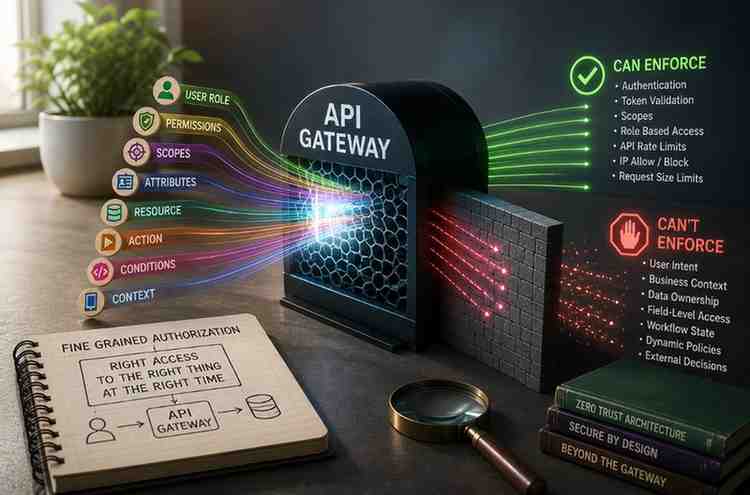

Complexity is the silent thief of system performance. Most engineers treat security as a static barrier but true control requires a more fluid touch. You want your system to know exactly who belongs where without slowing down the flow of data.
When you implement fine-grain authorization your system can make more precise access decisions based on user identity resource attributes, relationships and runtime context instead of relying on broad static permissions. This approach ensures your architecture thinks for itself and keeps moving at full speed.
What Fine Grained Authorization Actually Means at Runtime
Runtime authorization evaluates whether an authenticated principal such as a user service or workload is permitted to perform a specific action on a protected resource based on current policies and contextual information. Real control happens when you verify the data and the current situation before letting any request through your gateway.
- Contextual Awareness. Every request can include identity claims and contextual information, such as device details, IP address, authentication method, or session metadata, that can help inform authorization decisions.
- Depending on your security requirements, authorization decisions may consider contextual information, such as device posture, authentication strength, time, network location, or other environmental attributes.
- Resource Level Logic. Your system needs to confirm if a user can edit a file or view a record based on who actually owns it. Instead of blocking or allowing access at the front door you check if the request matches the resource owner. API gateways like Kong Gateway can enforce authorization decisions alongside external policy engines or application services that evaluate resource ownership and business rules.
- Dynamic Policy Evaluation. Rules change faster than your code updates so you need a way to apply policies instantly. Modern authorization engines evaluate policies using current policy data and relevant resource information while relying on synchronized data or caching to minimize latency.
Why Teams Push Authorization to the Gateway
Most engineering teams start by putting security rules directly into the gateway because it feels like the cleanest place to stop bad requests. API gateways provide a centralized enforcement point for many external requests but backend services should also perform authorization checks where appropriate as part of a defense in depth strategy.
The Natural Chokepoint
Keeping security at the edge gives you one place to manage access for the entire system. You can watch everything from one dashboard rather than hunting through logs in many different spots.
According to experienced engineers on Reddit, relying solely on a gateway for security is a common trap; always practice defense in depth by verifying authorization at every layer
- Traffic Management. You can block unauthorized users before they consume any expensive backend resources or server memory.
- Consistency Across Services. Since every request travels through the same entry point you ensure that security standards remain uniform for every single service.
Where It Wins
Moving security logic to the perimeter gives you an immediate advantage when you need to deploy changes across your entire tech stack. You can update a policy in one spot and see it take effect instantly without needing to redeploy every individual service.
This is incredibly helpful when you are working with tools like Apache APISIX that can efficiently enforce authorization decisions and integrate with external policy engines for more advanced authorization requirements.
- Rapid Policy Updates. You can roll out security changes across your entire environment in seconds rather than waiting for a slow build and deployment cycle.
- Centralized Security Audits. Having one place for all your security decisions makes it easy to generate reports for compliance or internal reviews.
Where Fine Grained Authorization Breaks at the Gateway
Trying to squeeze deep authorization logic into your gateway often feels good until you reach a certain level of system maturity. You will eventually notice that the gateway is not actually built to understand the heavy data relationships that your business logic relies on.
According to expert insights on platforms, authorizers with your gateway provides flexible control but managing complex state across many services can quickly become a challenge.
Blind to Your Data
Your gateway usually sits at the edge of the network and it has no native access to the deep internal state of your databases. It can read a token or a user ID but it cannot see the specific rows or the complex state of an object that a user is trying to touch.
- Missing State Awareness. Most API gateways do not natively understand application-specific ownership relationships and typically rely on external authorization services or backend systems for those decisions.
- Contextual Limits. Decisions that depend on historical data or recent user activity become almost impossible to enforce at this level.
Claims Go Stale
Storing user data in a token is like taking a snapshot of them at one moment. If authorization decisions rely solely on long-lived tokens, permission changes may not take effect until tokens expire or are refreshed unless token introspection or continuous authorization mechanisms are used.
- Synchronization Gaps. Updates made to user roles take time to propagate and your gateway stays stuck in the past until the token is manually refreshed.
- Token Bloat. You might try to fix this by cramming more information into the token but that only makes your requests slower and harder to manage.
Logic Scatters
When you start moving complex security rules into the gateway you are actually spreading your business logic across two different locations. You end up with a messy situation where one part of your security lives in the infrastructure and another part lives in your code.
- Fragmented Maintenance. A simple change in how users access a resource requires you to touch both the gateway configuration and your application code.
- Hidden Dependencies. Your gateway starts to rely on specific response formats from your backend services which creates a rigid coupling that is hard to break.
Roles Explode
As your platform gets bigger you will need better ways to manage who can do what. If you try to list every single permission in your gateway your file will just become a big mess.
- Complexity Overload. The sheer volume of permutations leads to a configuration that no human can fully comprehend or manage safely.
- Fragile Configurations. Misconfigured policies can unintentionally grant or deny access which makes policy validation and testing important.
Who Can Access What
At the end of the day you struggle to answer simple questions about your security model when the logic is buried in the gateway configuration. You might see a request fail but you cannot easily trace which specific rule blocked it or why.
- Black Box Decisions. Depending on the gateway and its configuration diagnosing authorization decisions may require additional logging or integration with policy decision systems.
- Audit Trail Issues. Centralized logging at the gateway tells you that something was blocked but it rarely captures the specific intent or the business reason behind the denial.
How to Externalize Authorization the Right Way
Moving authorization out of the gateway is not just about changing where the code lives. It is about changing how you think about security. Instead of forcing your infrastructure to handle business decisions you let a dedicated system handle the heavy lifting.
Split Decision From Enforcement
You should aim for a model where your service asks a question and an external engine provides the answer. The gateway or service remains the enforcer that simply carries out the instruction it receives. By keeping the decision logic separate, you avoid mixing your business rules with your network traffic management.
- Clean Separation. The application code tells the authorization layer what the user wants to do and provides the relevant details.
- Easier Testing. Because the logic is now external you can test your security rules in isolation without needing to spin up the entire application.
The OPA Pattern
Using a tool like OPA lets you write rules in a language made just for security instead of standard code. It lives right next to your services so it can make decisions locally and right away.
- Policy as Code. You can store your security rules in version control just like your regular software. This means you can track changes and revert mistakes with the same tools you use for your feature development.
- Unified Decisions. Every service in your system talks to the same policy engine and follows the same rules.
Keep It Fast
Since you are asking an external source for every request, you must make sure it stays fast. Many authorization systems minimize latency by using local policy evaluation, caching, sidecars, or optimized remote services, though actual performance depends on the deployment architecture.
- Local Caching. Your authorization agent should keep the necessary policies and data in memory for lightning-fast lookups.
- Efficient Lookups. With smart indexing the engine finds the right answer in milliseconds. This makes sure security checks never stop your users from having a fast experience.
What to Look for in a Fine Grained Authorization Layer
Selecting the right tool for permissions is a major call that impacts your whole stack. You need something that can grow with your business and handle the odd cases that will surely come up.
Attributes and Context
The best systems for checking access do not just look at who you are, they look at the whole story behind the request. They pay attention to things like what the file is, how sensitive the data is and even the time of day.
- Rich Data Inputs. You want a system that can ingest external data like user attributes or system status to make informed choices. It is about having the right information at the right time to make a fair and accurate decision.
- Adaptive Rules. You can write policies that change their behavior based on the current context. It allows you to tighten security when you detect unusual patterns or risky behavior.
Live Decisions
You need a system that can adapt to data changes in real time without needing a full system restart. If a user’s access is revoked in the database, the authorization layer should know about it almost immediately.
- Real-time Updates. Depending on the implementation the policy engine may synchronize policy and attribute data through APIs, replication, polling, or event-driven updates. It removes the risk of stale permissions causing a security slip.
- Instant Visibility. Policy changes should propagate quickly and consistently across the system though the exact timing depends on the deployment architecture. This gives you peace of mind that your changes are taking effect exactly where they need to be.
Audit and Alerting
You need to know why a specific decision was made, especially when something goes wrong. A great authorization layer provides clear logs that explain exactly which rule was triggered and why a request was denied.
- Readable Logs. You should be able to look at a decision and instantly understand the reasoning behind it.
- Proactive Alerts. The system should warn you if it sees unusual patterns that might suggest a misconfiguration.
Fits Your Stack
The best tool in the world is useless if it does not play nice with what you already have. You need an authorization layer that integrates easily with your existing services and workflows. Whether you are running in the cloud or on-premise, the tool should feel like a natural extension of your environment.
- Language Agnostic. It should support your stack regardless of whether you are using Java, Go, or Python. You should not have to write custom wrappers just to get a simple permission check.
- Scalable Architecture. The tool should be built to handle your current traffic levels and scale up smoothly as your user base grows. It should be a foundation that supports your success rather than a hurdle you have to overcome.
Decide Where Authorization Lives Before You Scale
Scaling your infrastructure is like building a house where the foundation determines the strength of every wall you add later. If you pile all your security rules into the gateway while you are still small you will eventually hit a wall where maintenance becomes impossible.
You have to step back and decide if your gateway should be the one making complex choices or if it should just be the door that lets people through.
The Path Forward
When you reach the point where your access rules feel tangled and heavy you might find that Infisign UniFed offers a way to simplify things without adding extra friction. It functions as a bridge that connects your edge to your backend reality so that permissions stay accurate and fast.
- It utilizes context-aware intelligence to evaluate user data and resource states in real-time which enables the system to make smart access decisions that go far beyond standard static roles.
- The architecture is built for seamless integration into your existing stack as an invisible layer that preserves your service speed while removing the need for heavy re-engineering or manual updates.
- Adaptive agility is at the core of the platform so you can adjust your security policies on the fly to support your system evolution as your specific business requirements expand over time.
Your infrastructure should work for you not against you. If you want to see how this fits into your current stack let us chat. Pick a time on our demo page and we can talk through your setup.
FAQ
Can't our API gateway just handle authorization for us?
Gateways are good for basic front door security. But they cannot read your database state or understand complex data relationships. Forcing heavy business rules there creates a messy, unmanageable system.
We already use roles and JWT claims — why isn't that enough?
Tokens are like old snapshots. When access changes, the token stays valid until it expires. Listing every single permission also becomes way too complicated for any human to manage properly.
Won't externalizing authorization to a separate service add latency to every request?
Not if it is done correctly. Modern tools keep policies and data inside local memory. This smart caching allows them to answer all incoming requests in just a few milliseconds.
What should we look for in a fine-grained authorization layer?
You need a system that reads rich data, updates rules instantly, and writes clear logs. It must also fit easily into your current stack without requiring any heavy manual rework.


