


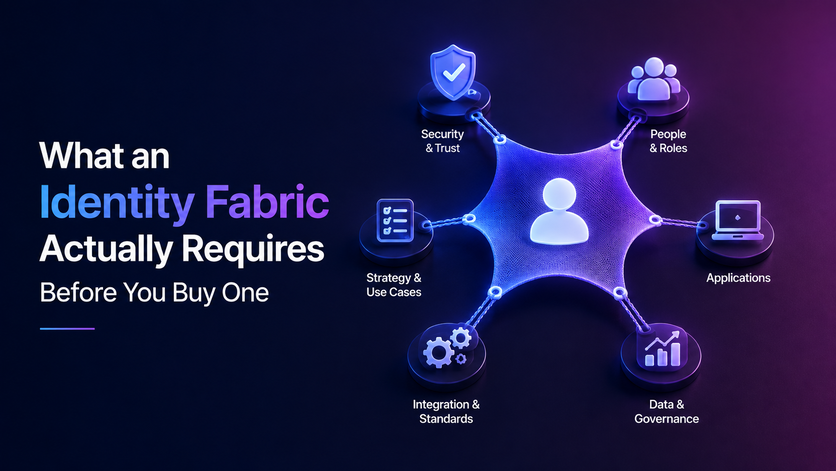

Enterprise systems struggle with scattered access tools built up over the years. This fragmentation creates security gaps while developers waste time writing custom permission checks.
An identity fabric addresses this fragmentation by connecting and orchestrating identity and access capabilities across an organization's environments.
Instead of forcing you to throw away old setups or manage separate directories this modern architecture unifies policy enforcement and live relationship mapping.
Organizations can use an identity fabric to improve access management, support hybrid and cloud environments, and apply more consistent security controls while reducing operational complexity.
What an Identity Fabric Is and What It Is Not
Enterprise architecture spent decades trying to fix user access by packing everything into single directories and rigid perimeters. Those old setups broke when systems spread across multiple clouds and outside workers gained constant access.
An identity fabric steps into this space to help. It is not a basic directory replacement or a standard product you buy off a price list.
Instead, it provides an architectural approach for integrating existing identity services and capabilities, allowing organizations to modernize identity management without necessarily replacing all existing systems.
What an Identity Fabric Actually Does
An identity fabric connects identity and access services across different environments to support more consistent policy management and enforcement. It can correlate identity, access, and contextual information across environments to improve visibility and support risk-aware access decisions.
- Dynamic graphs. Some identity fabric implementations use identity graphs or other relationship models to connect identities, resources, entitlements, and contextual information across environments.
- Instant response. If supported by the underlying identity and access services, an identity fabric can use changing risk or contextual signals to trigger adaptive access controls across connected resources.
Why Relying Only on Traditional Tools Is Dangerous
Sticking to old user lists creates massive identity silos when outside workers and cloud apps grow fast. Older setups cannot handle mixed cloud spaces safely by themselves.
- Lifecycle mechanics. A true system separates sign in rules from individual programs so developers stop writing custom checks. Shared tools handle zero trust access instead.
- Architecture gaps. Old layouts break down at single points when your setup uses many different vendors. A well-designed identity fabric can reduce these architectural gaps by connecting identity services and access controls across different environments.
Why Your Identity Stack Became Five Systems Nobody Fully Owns
Enterprise identity setups get messy over time due to company mergers and extra rule changes. You end up with separate tools managed by different teams. Ownership breaks down and leaves big security gaps that attackers can exploit.
Why Identity Ownership Breaks Down
Different departments manage separate pieces like local directories and cloud bridges. This separation causes confusion when nobody knows who set up old accounts.
- Departmental silos. Teams work apart without a shared data model. Security drops because everyone just reacts to problems.
- Invisible blind spots. Attackers find identity-based attacks fast while hidden tools and extra logins add more chaos.
Fixing the Structural Failure
Moving to a single sign-on (SSO) setup can reduce the number of separate application logins, but broader identity fragmentation may require additional governance, lifecycle, and integration capabilities.
- Unified graph mapping. An identity fabric can connect information about users, partners, applications, devices, and other identities across existing identity systems.
- Programmatic boundaries. The goal is to set clear limits instead of forcing every app into one brand. Modern systems use a strong identity fabric IAM approach to handle challenges without breaking your current work.
The Six Layers an Identity Fabric Has to Cover
A well-designed identity architecture should address the identity, access, governance, lifecycle, integration, and visibility capabilities required by the organization's environment.
The Core Operational Layers
Building a secure framework means managing telemetry and rules across your entire network setup. Each tier handles a specific task to keep user access safe and smooth.
- Signal Ingestion and Telemetry Layer. Some identity fabric implementations incorporate contextual signals from identity, device, application, and security systems to support more informed access decisions. It pulls live signals from device health checkers and threat feeds. Without this data multi-factor authentication checks rely only on basic static details.
- Universal Directory and Graph Layer. An identity fabric can connect identity information across directories and other systems, with some implementations using relationship or graph models to represent connections among identities, resources, and entitlements.
Policy Enforcement and Management
Handling rules and life cycles automatically stops unauthorized access before problems start. These tiers manage decisions and keep your compliance logs clean.
- Policy Orchestration and Decision Engine Layer. This part separates rule checking from your main app logic. It evaluates access requests against applicable policies and can support real-time or near-real-time decisions where the underlying architecture permits it. The system adapts dynamically based on risk scores and time.
- Enforcement and Mediation Layer. An enforcement layer can apply identity and access decisions to connected applications through mechanisms such as APIs, gateways, proxies, federation, or application integrations, depending on the environment.
Lifecycle and Observability Control
Automation and clear visibility protect your infrastructure when workers join or leave the company. Keeping tamper proof records makes compliance checks simple.
- Lifecycle and Orchestration Layer. Account setup and removal must work automatically across hybrid environments. This tier handles user changes and instant offboarding everywhere. It automates account and access changes across connected systems, helping organizations remove access promptly when an employee leaves.
- Audit and Analytics Layer. Compliance and threat hunting demand continuous visibility into daily events. This tier can centralize or correlate available identity and access events to support monitoring, auditing, and forensic analysis. It provides clean data for forensics without manual gathering.
Where Identity Fabric Projects Actually Break
Deploying a new identity fabric sounds great on paper but teams often hit major roadblocks during setup. Fixing these issues early prevents projects from failing before they launch.
- Data quality issues. Companies assume user directories are clean before finding duplicate accounts and broken schemas everywhere. Pushing dirty data into the graph creates false alerts and halts automated workflows.
- Performance latency trouble. The system sits right in the middle of sign in paths where every millisecond counts. If evaluation engines take too long users experience lag and demand ways to bypass the setup.
- Political friction inside IT. Different technology and security teams may have competing priorities or ownership responsibilities, which can slow identity modernization initiatives.
- Legacy system integration. Older mainframes and database suites do not support modern protocols or APIs easily. Building secure adapters for these systems demands specialized engineering work that often exceeds original budgets.
What Changes When AI Agents Start Requesting Access
AI agents can introduce new identity and authorization challenges because some agents can perform tasks autonomously across applications, APIs, and cloud environments. This shift breaks old identity rules built for people sitting at keyboards.
- Dynamic scopes and blast radius. Standard access control fails when agents need broad permissions for audits. The system must adjust access scopes instantly based on the sensitive data being processed.
- Token management and delegation. Organizations should define how delegated agent access is limited, monitored, and revoked when the originating user's authorization or session ends. Tracking access across chained agent calls gets very complex.
- Non human growth and monitoring. Modern enterprises can have large and growing numbers of nonhuman identities, including service accounts, workloads, devices, API credentials, and autonomous agents.
How to Sequence an Identity Fabric Rollout
Deploying identity architecture incrementally can reduce operational risk and give teams opportunities to validate integrations and policies before expanding coverage.
- Discovery and Graph Mapping. Begin by auditing every existing identity store and directory across the enterprise. Use available discovery and identity security tools to identify unmanaged applications, accounts, and standing privileges before making significant policy changes.
- Signal Ingestion and Observability. Connect telemetry sources and endpoint tools to the ingestion layer without enforcing rules yet. Run the engine in shadow mode to observe traffic and eliminate false positives.
- Non Critical Application Pilot. Select a cohort of internal tools to pilot the enforcement and mediation layer. Route authentication through the fabric for this group to iron out latency and test scripts.
- Privileged and Machine Identity Integration. Extend coverage to service accounts and administrative access to harden defenses. Bringing these high-risk accounts under appropriate policy controls can reduce opportunities for unauthorized lateral movement.
- Core Enterprise and External Ecosystem. Finally integrate core apps and customer portals once data models are mature. This allows the system to handle full scale enterprise traffic without disruption.
The Questions to Ask Before You Sign Anything
Software vendors often rebrand old tools as identity fabrics. Security architects must ask tough technical questions to cut through marketing claims before buying.
- Graph storage capabilities. Ask how the platform stores and queries user relationships in real time. Demand proof that the system handles complex multi hop queries without slowing down.
- Authentication latency impact. Request exact benchmark data showing decision response times under heavy enterprise load. The system must not create lag on the sign in the critical path.
- Legacy protocol translation. Check how the setup handles older apps that do not use modern standards. Look for pre-built adapters instead of needing custom code for every system.
- Policy simulation testing. Ensure the platform lets you test new rules against live traffic safely. Running in shadow mode helps prevent blocking legitimate user access during trials.
- AI and non-human support. Verify how the architecture manages automated workloads and delegation chains. The system must support short lived tokens and behavioral checks for machines.
- Vendor directory decoupling. Make sure the fabric does not lock you into a single ecosystem. Leaving the vendor should not force you to rip out your entire security infrastructure.
Build the Fabric Before the Next Acquisition Decides For You
Corporate growth via company mergers brings messy identity setups into your business. Waiting for a deal to happen forces security teams to build weak temporary fixes that create long term risks.
- Proactive fabric integration. Building a fabric early turns messy mergers into simple tasks. You register the new company as a trusted source instead of moving millions of users into old directories.
- Regulatory compliance readiness. Global privacy rules and zero-trust mandates demand fast adaptation. A central orchestration layer lets you update policies overnight without draining your engineering budget.
- Long term control. Technology will keep changing as cloud providers and autonomous agents grow. Treating identity as a core architecture keeps your organization in control of its data boundaries.
Enterprise setups can struggle with fragmented identity and access systems. Infisign UniFed is designed to connect identity and authentication capabilities across different environments within a unified framework.
- Infisign UniFed helps connect identity and authentication capabilities across different systems to simplify identity management.
- Automated synchronization can keep user information aligned across supported systems while reducing the amount of manual identity administration.
- Modern face scans, fingerprint authentication, and password-free logins block hackers and protect daily work.
Bring order to scattered login tools and secure your entire infrastructure. Test drive modern authentication workflows directly on the Infisign demo page today.
FAQ
1. How does an identity fabric protect legacy systems alongside modern cloud apps?
An identity fabric acts as a smart layer on top of your existing setup. It translates protocols and maps user access without forcing companies to throw out older infrastructure or rewrite application code.
2. Why do growing enterprises struggle with scattered user directories?
Company mergers, regional teams, and separate cloud tools create isolated identity silos. This fragmentation leads to invisible security blind spots, broken accountability, and high manual overhead for IT administrators.
3. How does automated directory synchronization reduce operational costs?
Automated syncing eliminates manual data entry and human error. It keeps user lists updated instantly across hybrid environments, ensuring permissions change the moment an employee joins, moves, or leaves.
4. What role do modern passwordless methods play in enterprise security?
Passwordless options like biometrics and adaptive verification remove the risks tied to weak credentials. They block brute-force attacks and stop unauthorized lateral movement across corporate networks efficiently.
5. Why is a phased rollout recommended when deploying an identity fabric?
Deploying everything at once risks operational downtime. Starting with discovery, shadow mode testing, and low-risk pilots lets teams iron out latency issues before securing core applications.


