


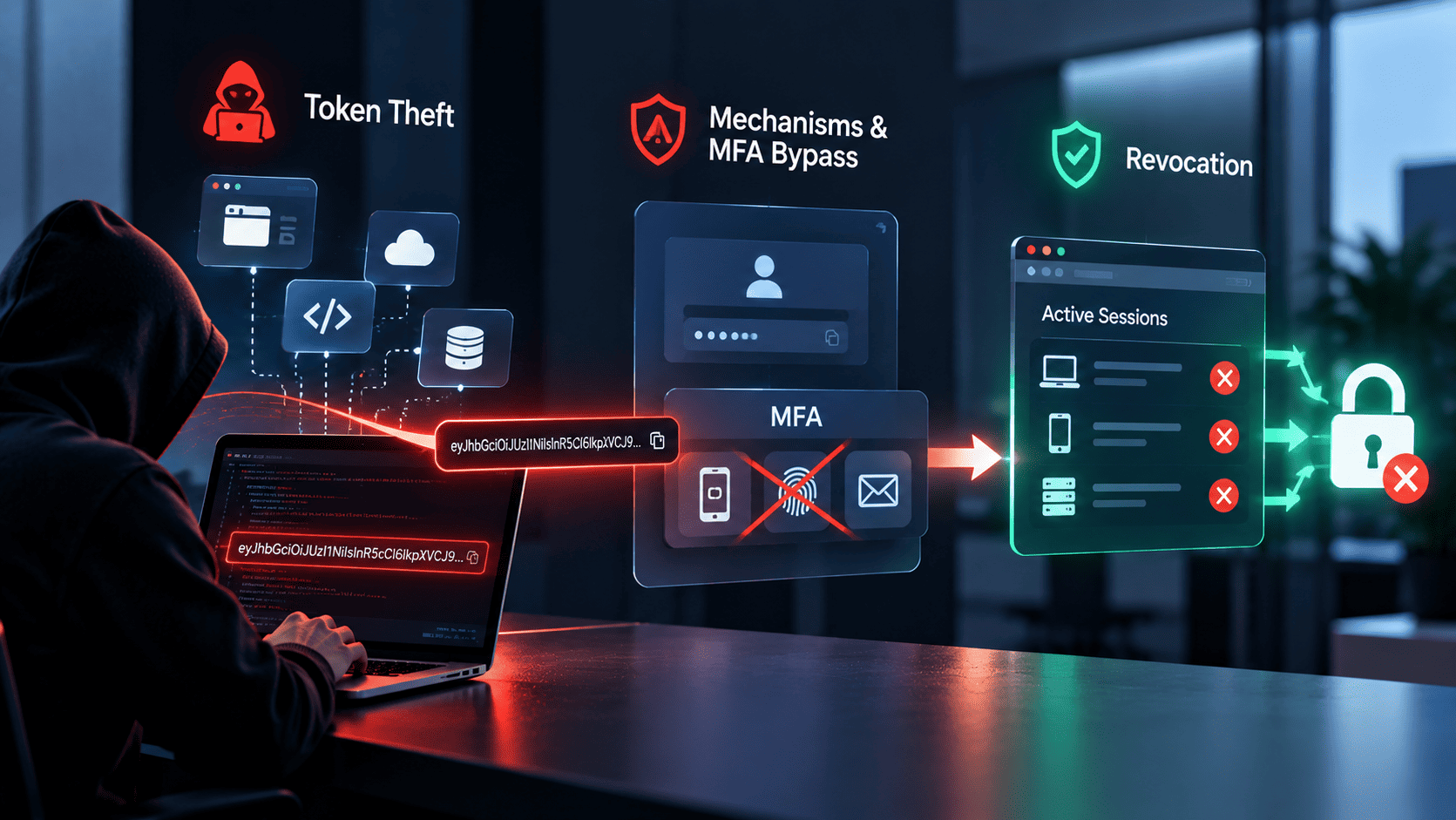

Online security often focuses entirely on login pages, leaving digital doors open after people successfully sign in. Criminals now target the very keys computers use to remember active users across the web. This form of cyber threat allows bad actors to bypass security prompts without knowing passwords or facing multi factor checks.
Understanding token theft helps everyday people and organizations protect active sessions from unauthorized entry, keeping private accounts safe from silent takeovers and unwanted intruders.
What Is Token Theft and How Does It Work?
Account takeovers happen every day even when people make no errors at all during their online activities. Criminals target active session tokens that computers use to remember successful logins.
By stealing certain valid session secrets or bearer tokens, attackers can sometimes gain access to an already authenticated session without having to complete the original MFA challenge again. This depends on how the application manages sessions and controls access tokens.
Good security looks past simple login pages to watch over the entire online visit from beginning to end.
Digital session exploitation happens when attackers steal something that has already been trusted by a system. This could be a session cookie or an access token. Once stolen, it lets an attacker step straight into an active account without knowing the password or facing any security checks.
That is what makes session hijacking so dangerous. The attacker does not break the front door open. They use a key that was already given to someone else during a normal login process.
- Bypassing Logins. This method bypasses the login battle completely. Attackers do not always need to crack passwords or defeat security prompts because a compromised credential makes systems believe attackers are authenticated as real owners.
- Ubiquitous Tokens. Tokens exist everywhere in modern digital environments. Browsers, mobile applications, application programming interfaces, and cloud services constantly create tokens to keep users connected safely. Cookie theft gives attackers access to active sessions without victims realizing anything went wrong.
- Multiple Attack Vectors. Attackers possess multiple ways to steal these digital credentials. Infostealer malware grabs browser cookies and tokens directly from personal or work devices. Supply chain attacks expose authorization grants and application programming interface keys.
- Growing Threat. The threat continues to grow as organizations rely more heavily on cloud services and multiple factor authentication. Protecting the login screen alone is no longer enough to keep accounts safe from determined criminals.
What Is a Session Token?
A session token is a small piece of data that server systems give browsers after users log in successfully. It tells websites that persons already proved their identity. Because of this token, users do not have to enter passwords every single time they open new pages or click links. It makes digital life much easier for everyday people.
But there is a catch. If someone steals that token, they can use the session as if they were the original owner. This turns session token theft into a serious security risk for individuals and businesses alike.
- Temporary Key. After users log in, tokens become proof of trust. Websites see tokens and know sessions remain valid without asking for passwords or security checks again.
- Security Risk. Many access and session tokens act as bearer credentials, which means anyone who possesses them may be able to use them. In contrast, sender-constrained tokens require additional proof of possession before they can be used.
- Post Login Threat. Security teams often focus heavily on protecting login processes themselves, but access token theft happens after authentication has already succeeded.
Access Tokens vs. Refresh Tokens
Access tokens and refresh tokens both help keep users signed in, but they fulfill very different roles.
An access token is used to access protected resources, while a refresh token can be used to obtain new access tokens when allowed by the authorization server. How long these tokens remain valid depends on the application's implementation and security policies.
Understanding this difference matters because refresh token theft gives attackers much longer windows to stay inside accounts. Following OAuth 2.0 best practices can help reduce these risks.
- Access Tokens. Used to access application programming interfaces and services with short lifetimes. They travel directly with application programming interface requests and require short expiration times and secure storage.
- Refresh Tokens. Used to get new access tokens when old ones expire. They last much longer, stay stored securely, and require proper revocation mechanisms when incidents occur.
- Core Risks. A stolen access token may only be useful for a short period if it expires quickly. However, a compromised refresh token can provide longer-term access if the authorization server continues to accept it and issue new access tokens.
How Session Token Theft Leads to Session Hijacking
Unauthorized access can happen when attackers acquire valid digital keys and use them to enter accounts belonging to other persons. Understanding session hijacking is important because the attacker may not need the password or MFA at all.
The scary part is that to systems, it looks like real users remain behind screens. Token replay can be hard to distinguish from legitimate activity because the attacker is using a valid credential. However, unusual behavior, device information, location changes, and token usage patterns can help identify suspicious activity.
- Session Loading. Once attackers get valid digital keys, they load them into their own browsers. Applications accept them without asking for passwords again.
- Unnoticed Attacks. Hijacked sessions can be difficult to detect because the attacker may be using a valid session credential. However, security systems can still spot suspicious activity by monitoring changes in devices, locations, applications, and user behavior. Hijacked sessions may produce fewer failed login attempts because attackers are using valid session credentials. However, unusual devices, locations, application activity, and resource access patterns can still help security teams detect suspicious behavior.
- Wider Access. One session can open more doors. If victims have access to email files, administrator tools, or connected cloud applications, attackers inherit that access too. A single compromised session becomes much bigger than one compromised account. What makes it painful is that victims may have done nothing wrong at all.
How AiTM Attacks Bypass MFA Through Token Theft
An AiTM (Adversary-in-the-Middle) attack places an attacker-controlled intermediary between a user and a legitimate authentication service. Attackers often use a phishing proxy to relay the authentication process and capture credentials or session cookies.
Users complete real security challenges without realizing anything is wrong. Using phishing-resistant MFA can help protect against these attacks.
Depending on how the system is implemented, attackers may capture session cookies during the authentication process and replay them later. In some cases, they can also cause authentication artifacts to be issued to infrastructure under their control.
In simple words, victims prove their identity successfully, but attackers walk away with the trust that comes after authentication.
- Proxy Positioning. Attackers stand in between users and servers. Victims click phishing links that look like real login pages. Proxies belonging to attackers pass information to real services so login and security processes succeed.
- Bypassing Security. Victims really do complete security checks, so there is no failed security warning. The problem happens afterward when attackers use stolen credentials to act as users without going through security again.
- Post Login Exposure. Once inside accounts, attackers read emails, access files, or reach connected services. In some cases, stolen credentials also help attackers obtain longer lasting access.
Access Token Theft vs. Refresh Token Theft
Comparing different token types shows how the level of risk differs greatly. Short lived credentials usually expire quickly, which limits how long attackers can use them. Longer lasting credentials can be used to create new entries continuously. This makes certain types of credential compromise a more serious and urgent security concern for organizations.
- Lifetime. Access tokens are usually short lived, while refresh tokens are usually longer lived.
- Risk Levels. Short lived credential risk is limited by expiry times, whereas long lived token compromise allows persistent access.
- Attackers Goal. With short credentials, criminals want to use them before expiration. With refresh tokens, their goal is generating new entries continuously.
- Access Nature. Short-lived access tokens may only be useful for a limited time before they expire. However, a compromised refresh token can allow continued access as long as the authorization server continues to accept it.
- Revocation Rules. Whether an access token can be revoked directly depends on the authorization system. Some systems rely on token expiration, introspection, continuous access evaluation, or other security mechanisms. The ability to revoke refresh tokens also depends on how the system is implemented.
- Response Strategies. To respond to security incidents, teams monitor activity and limit token lifetimes while revoking compromised refresh entries immediately.
Common Token Theft Attack Vectors
Compromising digital keys happens in many different ways. Attackers target user devices or trick people during login. They also steal entries from applications, systems, or third party services. Knowing these common paths helps organizations protect digital keys before bad actors reach them.
- Infostealer Malware. Malware silently steals cookies and tokens from compromised devices. If someone remains logged into several services at once, the same malware collects credentials from multiple accounts simultaneously.
- Phishing Proxies. Fake login pages placed between users and real services let victims complete real login and security processes while attackers intercept session tokens created afterward.
- Stolen Credentials and Secrets. Tokens leak from code repositories, logs, chat messages, build systems, and third party vendors. Once exposed, attackers reuse them to enter connected systems.
How to Detect Token Theft and Token Replay
Compromising active sessions remains hard to spot because attackers use keys that systems already trust. There are no failed logins and no obvious security warnings. That is why security teams need to look closely at what happens after login.
- Unusual Activity. The sudden use of valid tokens from unfamiliar devices, locations, IP addresses, or unusual access patterns can be a valuable risk indicator. These signals become even more useful when they appear alongside other suspicious or anomalous activity. For example, users log in from one location, and moments later, the same tokens start making requests from other places.
- Strange Patterns. Sudden increases in application programming interface requests, unusual access to sensitive files, or activity from unexpected devices should raise concern. Teams should also watch for unusual token reuse patterns because compromised keys help attackers stay hidden for longer periods.
- Strong Logs. Good logs show what happened after keys were compromised and help teams understand how far attackers went. Keeping track of devices, locations, applications, and connected services makes it easier to spot unusual behavior.
How to Revoke Stolen OAuth Tokens
When digital keys are compromised or strongly suspected to be stolen, the priority is cutting off attacker access as quickly as possible. Exact steps depend on token types and platforms in use.
- Revoke Active Access First. Revoking a compromised refresh token can stop the issuance of new access tokens. However, any access tokens that have already been issued may continue to work until they expire or are rejected by the resource or identity system.
- Limit Access Token Exposure. Access tokens may not always be revoked immediately because some platforms only allow teams to control how long those tokens remain valid.
- Secure Wider Environments. Revoking one token is never enough by itself. Teams should check connected apps, sessions, application programming interface keys, and other credentials that might also be exposed. Proper OAuth token revocation helps limit the damage.
How to Prevent Token Theft and Session Hijacking
Stopping unauthorized access requires adding multiple layers of protection so even if one layer fails, attackers still struggle to obtain useful access. Good security protects digital keys from creation until expiration.
- Limit Token Lifetimes. Keep access tokens short-lived where appropriate to limit the impact of token theft. You can further reduce risk by using refresh-token rotation or sender-constrained refresh tokens when supported by the system.
- Store Tokens Safely. Keep tokens in secure storage locations instead of local storage or URLs to prevent scripts and external attackers from reading them easily.
- Make Tokens Less Useful. Bind tokens to specific devices or clients when possible. Enforce phishing resistant security keys and keep token permissions narrow.
Token Theft Response: What to Do After a Token Is Compromised
When digital keys are compromised, every minute matters. The goal is stopping attackers quickly while figuring out what happened. Calm and well planned response limits damage and protects users from much bigger breaches.
- Contain Threats Immediately. Revoke affected sessions and refresh entries as quickly as possible. If signing keys leaked, rotate them as well.
- Preserve and Communicate. Do not delete or rotate everything before collecting important logs and evidence. Affected users should receive clear explanations and instructions to sign in again.
- Strengthen Systems. Check connected apps, application programming interface keys, and other services that trusted compromised tokens.
Token Theft vs. Other Identity Attacks
Compromising digital keys differs from many common identity attacks because it targets trust created after successful logins. Password attacks try breaking through login doors, while session exploitation starts after those doors are already open.
- Password Theft. Steals or guesses credentials that still need to pass login processes, whereas session compromise targets already trusted entries.
- Man in the Middle. Focuses on watching or changing data moving across networks, while proxy exploitation targets sessions through phishing.
- Brute Force. Brute-force attacks involve repeated authentication attempts, which often generate failed login events that can be detected by security systems. In contrast, a stolen valid session credential may allow an attacker to access a session without performing a new password-based login.
- Session Fixation. Tricks victims into using session identifiers known to attackers, whereas credential compromise involves obtaining tokens already issued to real users.
Token Theft Prevention Checklist
- Short Lifetimes. Keep access tokens appropriately short-lived to reduce the impact of token theft. Where supported, rotate refresh tokens each time they are used so that attempts to reuse an invalidated refresh token can help identify a possible token compromise.
- Secure Storage. For browser-based applications, avoid storing authentication credentials such as session IDs and refresh tokens in localStorage or sessionStorage. Where appropriate, use Secure, HttpOnly, and SameSite cookies, or adopt an architecture that keeps tokens out of browser-accessible storage.
- Sender Constrained Tokens. Where supported by the OAuth architecture, use sender-constrained access or refresh tokens, such as DPoP-bound tokens, to make it more difficult for attackers to replay stolen tokens.
- Conditional Access. Use conditional access and continuous security checks instead of trusting sessions only because they passed initial logins.
- Phishing Resistance. Use phishing resistant security methods and watch for fake login pages, lookalike domains, and proxy phishing attempts.
- Narrow Permissions. Keep token permissions as narrow as possible so compromised keys provide only minimal required access.
- Track Services. Keep track of third party authorization apps and connected services to prevent single compromised keys from spreading.
- Centralize Logs. Centralize security logs and watch for unusual locations, devices, login patterns, and sudden activity increases.
- Know Revocation Tools. Know what identity providers can revoke before incidents happen by understanding how to revoke sessions, refresh entries, and signing keys.
- Preserve Evidence. Preserve important logs and evidence before rotating credentials during incidents to understand how far attackers went.
- Remove Unused Access. Regularly remove unused authorization permissions and old application programming interface keys or refresh entries.
- User Education. Teach users to recognize suspicious login pages, unexpected login requests, and lookalike domains.
Token theft does not always happen because someone has weak passwords. Sometimes problems start after users log in. Stolen session tokens make attackers look like trusted users, which is why protecting sessions after login remains just as important as protecting logins themselves.
Infisign UniFed helps organizations address post-authentication risk through phishing-resistant authentication, adaptive access controls, and continuous identity verification. These capabilities are designed to reduce the risk of unauthorized access and help limit the impact of compromised credentials or sessions.
- Phishing-Resistant Authentication and Passkeys. Supports phishing-resistant authentication methods such as passkeys and biometric verification. These methods can help reduce the risk of credential theft and authentication interception during sign-in by using device-bound cryptographic authentication instead of shared secrets. Additional session security controls may still be needed to help reduce post-authentication token or session abuse.
- Conditional Access Controls. Supports conditional access policies that can evaluate signals such as device state, location, network conditions, and other contextual factors when making access decisions. Organizations can use these signals to apply risk-based authentication requirements and access controls based on their security policies.
- Zero Trust Principles. Supports Zero Trust security principles by enabling access decisions based on identity, device posture, resource sensitivity, policy requirements, and other relevant signals. Rather than relying solely on an initial authentication event, access can be continuously evaluated throughout a user's interaction with applications and services.
Your users trust you with more than passwords. Protect that trust after login too. Explore how Infisign UniFed can help keep every identity and session safer. Schedule a meeting with our team.
FAQ
What is token theft?
Token theft is when attackers steal valid authentication tokens, such as session cookies or access tokens, and use them to access accounts without logging in again.
Can token theft bypass MFA?
Yes, token theft can bypass multiple factor authentication because attackers use tokens created after successful authentication. Systems trust those tokens without asking for further security challenges.
What is an AiTM attack?
An aitm attack places fake proxies between users and legitimate websites, relaying login and security processes while secretly obtaining resulting session tokens.
What is a token replay attack?
A token replay attack happens when attackers steal valid tokens and use them again to access systems, impersonating legitimate users.
What is the difference between access token theft and refresh token theft?
Access token theft usually provides short term access until expiration, while refresh token theft is more dangerous because attackers use stolen refresh tokens to obtain new access tokens.


