



Auth0 and Descope are two popular CIAM platforms for modern authentication and customer identity management. Both platforms support enterprise SSO and passwordless login. Both also help companies manage customer access at scale. The real difference appears when teams compare pricing and developer experience.
Some companies want deeper enterprise control. Other teams care more about faster setup and lower engineering effort. This Auth0 vs Descope comparison breaks down features and pricing. It also explains which platform fits different CIAM use cases more naturally.
Auth0 vs Descope at a Glance
Auth0 and Descope both offer strong CIAM capabilities for modern applications. Both platforms support passwordless authentication and enterprise SSO. The biggest difference appears in implementation style and pricing flexibility.
Auth0 focuses more on enterprise extensibility. Descope focuses more on faster deployment through tools like Descope flow builder and no-code authentication experiences.
According to a Reddit discussion, community discussions frequently highlight that while Auth0 offers unmatched depth, growing B2B teams often find Descope's visual-first approach faster for managing complex tenant structures.
Core Capabilities
Auth0 works well for enterprises that need mature infrastructure and advanced customization. Descope works better for teams that want modern authentication with faster implementation and lower operational complexity.
Which One Is Probably Right for You
Picking the right login system is a big step for your app. Since both platforms use MAU pricing, you need to think about how your costs will change as you add more users. Auth0 often requires more configuration and customization for advanced enterprise identity scenarios while Descope focuses on speed to help you launch faster.
Evaluating Your Identity Strategy
- Move Faster. If your goal is to launch quickly, Descope no code authentication is a perfect fit. It uses a simple visual tool so you can build login screens in minutes. This lets your team focus on your main app instead of spending time on technical setup work.
- Detailed Control. Auth0 is a common pick for very large companies that need very specific security rules. It gives you a lot of control, but it takes more time to get running and keep updated.
- Avoid Future Roadblocks. Growing an app can be tricky. As Mark Bjerke, Enterprise Account Executive at Descope, shares, many teams eventually find that their first login system slows them down. When costs become hard to guess or technical limits hurt the user experience, moving to a simpler system helps teams keep moving.
If you want an easy, predictable way to manage users as you grow, Descope is a great fit. If you have a massive company with very unique needs and a large technical team, Auth0 is an option to consider.
When Auth0 Is the Right Call
Auth0 works well for large companies with complicated login setups. Many businesses use it because it gives them a lot of control and strong security, making it a reliable pick for organizations that need to handle detailed rules for how users sign in.
- Enterprise Access. Large businesses often rely on Auth0 SAML SSO support to give their professional customers a safe and easy way to sign in.
- Custom Workflows. Auth0 fits teams that need specific login steps. If your app requires unique ways to verify users, this platform provides the tools to build what you need.
- Enhanced Security. For companies that need extra layers of safety, such as requiring a second code to sign in, Auth0 offers the depth required to keep accounts safe.
- Budget Management. While it is powerful, keep an eye on your costs. Many teams notice that Auth0 pricing can get quite high as your number of users grows.
- Engineering Focus. Because the platform is complex, it works best for companies with dedicated technical teams who have the time to manage and fine-tune their login setup.
When Descope Is the Right Call
Descope is a great fit for teams that want a modern login experience without the heavy lifting. It is built to help product teams move quickly, allowing developers to set up user authentication and handle onboarding flows without getting bogged down in complex backend work.
By 2026, Gartner reports that 75% of new enterprise applications will be built on low-code platforms, proving that visual-first tools are now the standard for high-performing teams. You can explore these 2026 low-code market trends to see why this shift is happening.
- Fast Implementation. Descope helps you launch login screens in minutes. Because it uses a visual builder, your team can design and change how users sign in without writing a mountain of code.
- Simple Enterprise Onboarding. For B2B products, Descope SCIM directory sync is a major time-saver. It automatically keeps your users and their group information in sync with their company’s internal directory, removing the need for manual setup.
- Flexible Workflows. The visual builder makes it easy to manage how users sign in. If you want to add new login steps or change the flow later, you can do it visually rather than reworking your entire app’s code.
- Modern User Experience. The platform is designed for today’s apps, making it simple to offer passwordless logins and smooth, professional sign-up journeys that users actually enjoy.
- Predictable Budgeting. Startups often prefer Descope pricing because it is built to be transparent as you scale. While every growing product needs to monitor its expenses, the cost model is designed to grow alongside your user base in a way that is easy to plan for.
Auth0 Features Worth Evaluating Before You Commit
Auth0 gives strong authentication and enterprise identity features. Many companies still review its setup and pricing before making a final decision. Some teams care more about security. Other teams focus more on developer experience and scaling costs.
Auth0 Limitations You Will Hit
Auth0 gives strong enterprise login and identity features. Many companies still face problems after their product grows and authentication becomes more complex. Most issues appear when teams start managing more enterprise customers and larger user volumes.
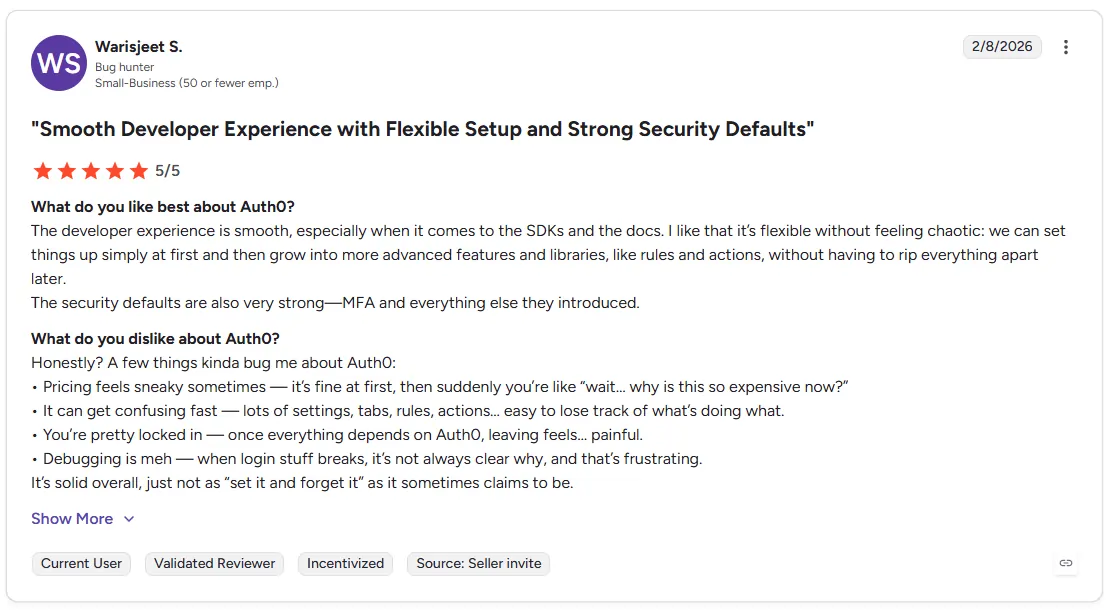
- Higher Costs. Some users have reported cost concerns as usage grows particularly when additional enterprise features and higher MAU volumes are required according to authentic reviews posted on the G2 software directory and Capterra software directory.
- More Setup Work. Some authentication flows need extra developer work and manual configuration. Teams with smaller engineering resources sometimes feel the platform becomes harder to manage over time.
- Learning Curve. New developers may need time before understanding Auth0 workflows and identity setup. Enterprise authentication systems can also feel confusing for teams without CIAM experience.
- Limited UI Freedom. Some companies want more control over login screens and onboarding design. Auth0 allows customization but some teams still feel restricted compared to fully custom authentication systems.
- Scaling Complexity. Managing enterprise onboarding and large tenant setups can become difficult later. Companies handling many enterprise customers often need more planning and developer support as systems grow.
Descope Features Worth Evaluating Before You Commit
Descope gives modern authentication features for SaaS and B2B products. Many teams like the platform because setup feels faster and easier to manage. Companies still review its workflows and scaling support before making a final decision. Some teams care more about developer speed. Other teams focus more on enterprise onboarding and long-term pricing.
Descope Limitations You Will Hit
Descope gives fast authentication setup and modern login features. Many companies still face some problems after their product grows and identity needs become more complex.
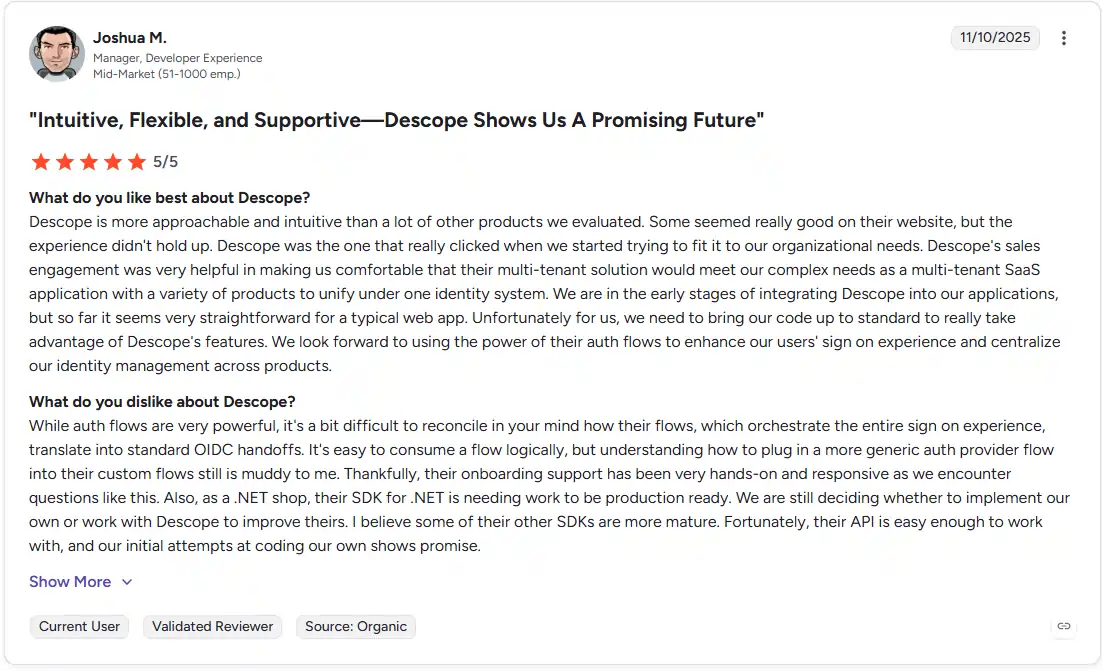
- Smaller Ecosystem. Descope has fewer integrations and community resources compared to older CIAM platforms like Auth0.
- Less Enterprise History. Some large companies prefer platforms with a longer enterprise track record and bigger market presence.
- Advanced Customization Limits. Some teams feel that very complex identity workflows need more flexibility than Descope currently gives.
- Learning New Workflows. Developers may need time to understand the visual flow builder and authentication logic.
- Enterprise Compliance Gaps. Companies with special rules should look at Descope certificates and match them with what they need because rules change in every business area and place.
Auth0 and Descope Pricing Breakdown
Pricing becomes a bigger factor as MAU grows. Many companies start with feature comparison. Later they realize authentication costs can increase very fast at scale. Auth0 and Descope both use MAU-based pricing models.
Descope usually feels cheaper for growing SaaS products while Auth0 often becomes more expensive at higher user volumes.
Pricing Comparison
Many startups and mid-market SaaS companies compare pricing very closely because CIAM costs grow with user adoption. Enterprise companies often focus more on customization and compliance even when pricing becomes higher.
Ready to Move Beyond Auth0 and Descope?
Auth0 and Descope both solve important CIAM problems. Many companies start with them because they help teams launch authentication faster and manage customer identity more easily.
Then things become bigger.
More enterprise customers start asking for custom SSO setup. More apps get added across the company. Identity workflows also become harder to manage over time. Teams slowly realize they are spending more effort connecting systems instead of simplifying access.
Some companies then start focusing less on standalone authentication tools. They start looking for ways to manage identity and access in a more unified way across apps and enterprise systems.
Managing fragmented customer identities can hurt your business growth and lower user trust. Infisign UniFed acts as a central identity gateway for your external users without forcing you to replace existing tools like Azure AD or Okta. This unified approach delivers real advantages across your digital network:
- Frictionless Sign-On. Your customers log in once and gain instant access to all your connected digital products. This creates a seamless journey across web apps or mobile platforms.
- Modern Passwordless Security. The system eliminates static passwords entirely. Infisign supports biometric validation and device passkeys to stop phishing attacks before they reach your customers.
- Unified Customer Visibility. Your team gets a single view of all customer actions across your apps. You can monitor user behavior and pull audit trails to make compliance reporting effortless.
- Instant Scalability. Your product team can go live with passwordless authentication in under four hours to reduce operational overhead.
When your customer base grows, managing authentication becomes increasingly complex. A unified approach helps keep identity management scalable, secure, and seamless in the long run. If you'd like to see how the platform works in a real-world environment, book a demo today.
FAQs
Is Descope a good alternative to Auth0?
Descope can be a viable alternative to Auth0, depending on requirements such as implementation preferences, enterprise integrations, authentication methods, and pricing considerations.
Does Auth0 support passwordless authentication?
Yes. Auth0 supports passwordless authentication through magic links and one-time passwords. Companies can also use passkeys and biometric login for modern customer authentication experiences.
Which is faster to implement Auth0 or Descope?
Descope visual workflow builder and low-code approach are designed to reduce implementation effort for many teams, although implementation timelines vary depending on application complexity and integration requirements.


